WordBinary Blog
Free Plagiarism Checker for Students: What Free Tools Can and Cannot Do
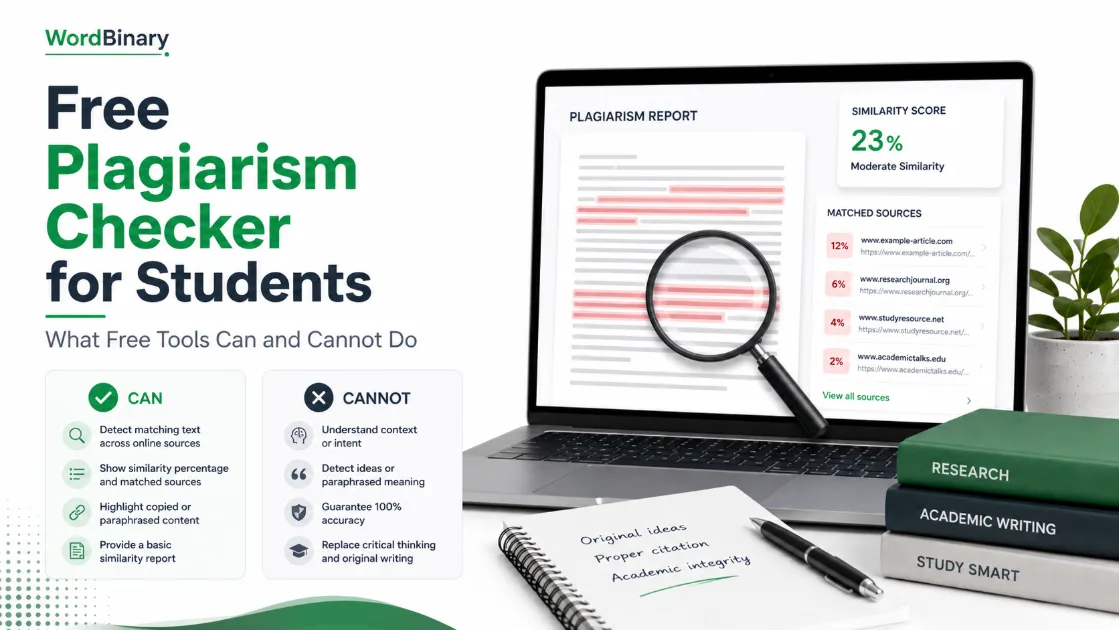
A free plagiarism checker can be useful when you are working on an essay at midnight, reviewing an assignment before submission or trying to find the source of a sentence you saved without proper notes.
The difficulty is knowing how much confidence to place in the result.
A tool may return a reassuring message such as “No plagiarism detected” or display a low similarity percentage. That does not necessarily mean the document is free from citation problems, close paraphrasing or unattributed ideas. At the other extreme, a high percentage does not automatically mean that the student has plagiarised.
The most useful way to approach a free plagiarism checker for students is to treat it as an early screening tool. It can identify certain forms of textual overlap and direct your attention to passages worth reviewing. It cannot make an academic judgement, guarantee that every source has been checked or determine whether your use of a source is acceptable under your university’s rules.
This article explains where free plagiarism tools genuinely help, where they commonly fall short and how students can interpret the results without becoming fixated on a single percentage.
Key Takeaways
- A free checker can identify some exact and closely matching text, especially where the source is publicly accessible online.
- A similarity percentage is not the same as a plagiarism verdict.
- A low result cannot guarantee that an assignment is properly cited or fully original.
- A high result may include quotations, references, assignment wording and common academic phrases.
- Source coverage, document limits, report detail and privacy conditions vary between tools.
- Students should review highlighted passages and matched sources instead of trying only to reduce the total percentage.
- Plagiarism checking, AI detection and grammar checking answer different questions.
- University guidance and the assessment brief should take priority over a tool’s automated result.
What Does a Free Plagiarism Checker Actually Check?
Most free plagiarism tools perform some form of text-matching process. They divide submitted writing into sentences, phrases or search fragments and compare them with content available through the tool’s search system.
When similar wording is found, the tool may provide:
- an overall similarity percentage;
- highlighted passages;
- links to possible online sources;
- a count of matching sentences;
- a label such as unique, copied or potentially plagiarised.
The exact process differs between services. Some tools search publicly indexed webpages. Others may also compare against licensed publications, previously submitted documents or private repositories. Free access, however, often comes with narrower search depth, shorter word limits or less detailed reports.
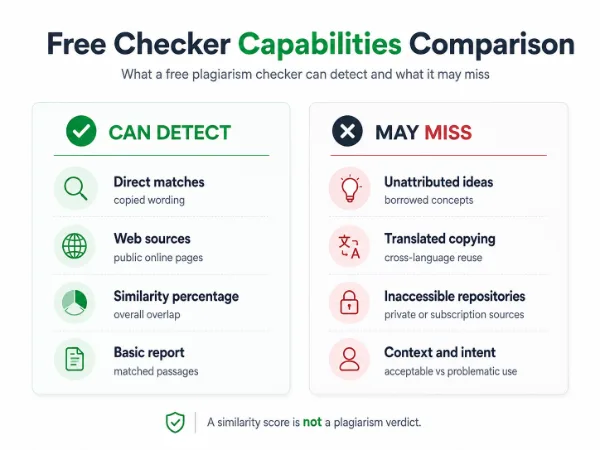
A proper similarity checker does not directly observe a student’s intention. It does not know whether a passage was copied deliberately, quoted correctly, paraphrased poorly or produced independently using similar technical language.
That distinction matters. Oxford defines plagiarism in terms of presenting material or ideas from another source as one’s own without full acknowledgement. This definition involves authorship and attribution, not merely the existence of matching words.
Turnitin’s official guidance makes the same core distinction: its Similarity Report identifies text that matches available sources, but it does not itself determine whether plagiarism has occurred.
Similarity Is Not the Same as Plagiarism
Students frequently use the terms “plagiarism percentage” and “similarity percentage” as though they mean the same thing. They do not.
A similarity score measures the proportion of text that appears to overlap with content found by the system. Plagiarism is an academic judgement about how words, ideas, evidence or creative work have been used and acknowledged.
Consider these two passages:
Example 1: High similarity but acceptable source use
A student includes a 70-word quotation, places it inside quotation marks and provides the correct citation.
The checker may highlight almost the entire quotation. That similarity is expected. The passage is not being presented as the student’s own wording.
Example 2: Low similarity but potentially serious source misuse
A student copies a distinctive argument from a journal article, changes much of the vocabulary and retains the article’s reasoning and structure without attribution.
A basic checker may find little direct overlap because many words have changed. The academic concern remains because the underlying idea and structure have been used without acknowledgement.
Turnitin explicitly warns that a high score does not always indicate plagiarism, while a low score does not establish that plagiarism is absent.
The percentage is therefore a starting point, not the final answer.
What a Free Plagiarism Checker for Students Can Do Well
Free tools have genuine value when their role is kept realistic.
1. Find obvious copied passages
A free plagiarism detector may identify sentences copied directly from:
- public websites;
- online articles;
- open reports;
- study notes published on the web;
- accessible research abstracts;
- other pages indexed by its search provider.
This is particularly helpful when a student has pasted notes into a draft and forgotten which sentences still require quotation marks or attribution.
2. Identify overly close paraphrasing
A checker may highlight a paraphrase where only a few words have been replaced.
For example:
Source:
“Employee engagement is strongly influenced by the quality of communication between managers and team members.”
Weak paraphrase:
“Staff engagement is heavily influenced by the standard of communication between managers and members of their teams.”
The second sentence changes some vocabulary but follows the original wording and structure closely. A similarity checker may help the student notice that more substantial rewriting and a citation are needed.
A stronger revision would first explain the idea from understanding, then cite the source:
Regular, two-way communication can affect how connected employees feel to their work and their immediate supervisors (Author, Year).
The citation remains necessary because the idea came from the source.
3. Locate forgotten sources
Students sometimes keep useful sentences in rough notes without recording the source immediately. Later, they may remember that the wording is not their own but be unable to locate the original page.
A checker can occasionally rediscover the source, allowing the student to:
- verify the original context;
- add the correct citation;
- quote the passage properly;
- remove it if the source is unreliable.
The tool should not replace careful note-taking, but it can help correct an earlier mistake.
4. Reveal repeated standard wording
Assignments in law, medicine, business, computing and the sciences often contain standard definitions, legislative titles, technical terminology or required task wording.
A free similarity checker may reveal that much of the reported overlap comes from these predictable areas rather than the student’s analysis. This helps the student separate meaningful matches from harmless or unavoidable similarities.
5. Support an early drafting check
Free tools are often most useful before the final version is complete.
Running an early check can help a student identify:
- sections based too heavily on one source;
- quotations missing citation details;
- passages that need more independent explanation;
- notes accidentally left in the main text;
- repetitive use of source language.
The purpose should be to improve source use, not to produce an artificially low number.
What Free Plagiarism Checkers Commonly Cannot Do
The word “free” describes the access model, not the completeness of the analysis. Students should understand the following limitations before relying on a result.
1. They may not search institutional repositories
One major difference between a basic online checker and an institutionally configured system is source access.
A free tool may search publicly available webpages but lack access to:
- previous student submissions;
- institutional repositories;
- subscription-only journals;
- books not openly available online;
- internal company documents;
- conference papers behind access controls;
- unpublished dissertations or theses.
A passage can therefore return no match simply because the relevant source is outside the tool’s comparison coverage.
“No match found” means only that the system did not locate a match within the sources it checked.
2. They cannot guarantee that work is plagiarism-free
No checker can certify that an assignment contains no plagiarism in every possible form.
Some forms of questionable source use do not depend on matching phrases. These include:
- using another person’s original idea without attribution;
- closely copying the structure of an argument;
- translating copied material from another language;
- presenting another person’s data or analysis as your own;
- submitting work written by someone else;
- recycling previous work where disclosure or permission is required;
- citing a source that does not support the claim being made.
A checker may assist with some of these problems, but it cannot reliably resolve all of them.
3. They may struggle with sophisticated paraphrasing
Basic checkers are generally better at finding direct overlap than identifying conceptually similar writing expressed in substantially different words.
This does not mean paraphrasing is a way to avoid plagiarism detection. A legitimate paraphrase must still acknowledge the source. Its purpose is to explain an idea accurately in the writer’s own reasoning and language, not to hide where the idea came from.
4. They may provide only a percentage
A result such as “18% plagiarism” is of limited value when the tool does not show:
- which passages matched;
- where the matched material came from;
- how much each source contributed;
- whether references were included;
- whether quotations could be excluded;
- whether repeated small matches were grouped correctly.
A useful report should allow the student to inspect the evidence behind the percentage.
WordBinary’s Plagiarism checker, for example, is designed to present highlighted overlap, available source information, similarity contribution and a downloadable report for contextual review. WordBinary also states clearly that similarity evidence does not automatically establish plagiarism.
5. They may impose short word limits
Some free services allow only a small section of text to be checked at one time. Students then divide a long essay into several pieces.
This can create problems:
- cross-section repetition may be missed;
- the overall percentage may be misleading;
- bibliography effects may not be visible;
- the student may lose track of which version was checked;
- copying and pasting may alter formatting or quotations.
Checking a 10,000-word dissertation in 500-word fragments is not equivalent to reviewing the document as a whole.
6. The source shown may not be the original source
A checker may find a sentence on a blog, document-sharing website or copied article even though the wording originally appeared in a book or research paper.
The matched webpage should therefore be treated as a lead, not automatically as the source that belongs in the reference list.
Students should trace important claims back to the original or most authoritative publication wherever possible.
7. They cannot decide whether a match is acceptable
A checker does not fully understand the purpose of a passage.
It may highlight:
- the assignment title;
- a standard laboratory method;
- legislation;
- a correctly cited quotation;
- an organisation’s official name;
- a common definition;
- a reference-list entry.
These matches need interpretation. Automatically rewriting every highlighted phrase can damage accuracy and produce unnatural writing.
Why a “0% Similarity” Result Can Be Misleading
A zero or very low percentage can feel like proof that an assignment is safe. It is not.
A low score may mean:
- the wording is genuinely original;
- the sources were paraphrased properly and cited;
- the relevant sources were not available to the checker;
- copied ideas were expressed in different language;
- translated material was not detected;
- the document was too short for meaningful comparison;
- the tool performed only a limited search.
The more useful question is not “How do I reach 0%?” It is:
Can I explain where every borrowed idea, quotation, figure and distinctive claim came from?
A paper with 8% similarity and transparent source use may be academically stronger than one with 0% similarity but weak, inaccurate or missing citations.
Why a High Similarity Percentage Is Not Automatically Bad
Higher similarity may result from legitimate features such as:
- long quotations required by the task;
- statutory or regulatory wording;
- a standard methods section;
- reference entries;
- a supplied cover sheet;
- a shared assignment template;
- repeated technical terminology;
- the title of a published scale or instrument.
The location and concentration of the matches matter.
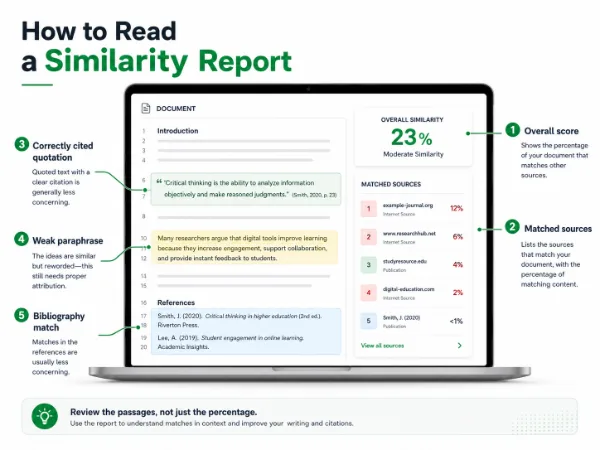
A single uncited paragraph copied from one source may deserve more attention than dozens of short matches scattered across a bibliography and common phrases.
Students should inspect:
- the longest highlighted passages;
- matches within the main analysis;
- sources contributing heavily to the score;
- passages cited but paraphrased too closely;
- quotations without clear formatting;
- references or templates affecting the total.
WordBinary’s similarity-report guidance recommends starting with the overall result but then examining matched sources, highlighted passages, citation quality and the academic context of each match.
A Practical Five-Step Review Process
Step 1: Check the assessment rules
Before using any external service, confirm whether your institution permits students to upload work to third-party checking tools.
Read:
- the assessment brief;
- your university’s academic integrity policy;
- data-handling instructions;
- any rules concerning unpublished research;
- any restrictions on generative AI or external writing tools.
Institutional policy is more authoritative than general advice from a software provider.
Step 2: Review the service before uploading
Check whether the tool explains:
- how long documents are retained;
- whether uploaded work enters a repository;
- whether content is used for training;
- how deletion requests work;
- which file formats are accepted;
- whether reports remain available;
- who can access the submission.
Avoid uploading confidential research, identifiable client information, unpublished commercial material or sensitive institutional documents when the service’s handling rules are unclear.
Step 3: Run the check before final formatting
Conduct the review while there is still time to improve the assignment.
Do not wait until five minutes before the deadline. A useful similarity review may require you to reopen sources, rewrite a weak paraphrase or restore a missing citation.
Step 4: Inspect every meaningful match
Do not respond to highlights mechanically. Classify each significant match as one of the following:
- correctly quoted and cited;
- properly paraphrased and cited;
- cited but too close to the source;
- missing attribution;
- common or required wording;
- bibliography or reference material;
- possible false or irrelevant match;
- source requiring manual verification.
Step 5: Revise the academic issue, not merely the wording
When a passage needs attention, identify the real problem.
If the citation is missing, add it.
If the paraphrase is too close, return to the source, make notes from understanding and rewrite the point independently.
If the paragraph depends too heavily on one author, compare additional evidence and add your own evaluation.
If a quotation is unnecessary, summarise the relevant idea and retain the citation.
Replacing words with synonyms simply to reduce a score is rarely a strong academic revision.
Common Mistakes Students Make with Free Tools
Chasing a universal “safe percentage”
There is no single percentage that is acceptable for every university, discipline or assignment.
A literature review, legal analysis and original reflective essay naturally produce different forms of source overlap. Universities may also apply different review practices.
Assuming citations cancel all similarity concerns
A citation acknowledges the source, but it does not automatically make a near-verbatim paraphrase acceptable.
Quotation marks may still be required where the source’s wording has been retained.
Removing valid citations to lower the score
Some students delete references, author names or necessary quotations because they increase the displayed percentage. This makes the paper less transparent and potentially less defensible.
Using several weak tools and averaging the results
Three free tools may produce three different percentages because they search different sources and process text differently.
Averaging the numbers does not create a more accurate result. Review the evidence each service provides.
Uploading confidential material without checking privacy terms
The urgency of an approaching deadline can lead students to paste unpublished dissertations, business documents or research data into unfamiliar websites.
Source checking should not come at the cost of confidentiality or institutional compliance.
Plagiarism Checking Is Not AI Detection
A plagiarism checker and an AI detector answer different questions.
A plagiarism checker looks for textual overlap with available sources.
An AI detector estimates whether writing patterns resemble text generated or substantially shaped by artificial intelligence.
A passage can therefore be:
- AI-generated but show little plagiarism similarity;
- human-written but closely copied from a source;
- fully original yet receive an uncertain AI signal;
- correctly quoted and show high textual similarity;
- poorly cited without containing AI-generated text.
Students concerned about AI-assisted writing can use an AI detector as a separate review layer. WordBinary presents document-level and sentence-level AI indicators as evidence for review rather than proof of authorship or misconduct.
Students should also understand that AI detection can produce false positives and false negatives. The WordBinary resource on AI Detection False Positives explains why formal, repetitive or highly structured human writing may sometimes resemble AI-generated text.
Where AI has been used, checking a score is not enough. The student should review the assessment rules, verify sources and determine whether disclosure was required. WordBinary’s Fair Use of Generative AI resource discusses the distinction between permitted support and hidden substitution of a student’s own work.
Grammar Checking Is a Separate Stage Too
An assignment may be original but difficult to read. It may also be grammatically polished while containing poor source attribution.
A Grammar checker reviews matters such as spelling, punctuation, sentence construction and clarity. It does not determine whether the writing is original or human-authored.
WordBinary allows users to review individual language suggestions and apply only the changes they consider appropriate, helping preserve technical meaning and discipline-specific terminology.
A sensible pre-submission sequence is:
- review sources and citations;
- inspect similarity matches;
- assess AI-related issues where relevant;
- improve grammar and clarity;
- complete a final manual proofread.
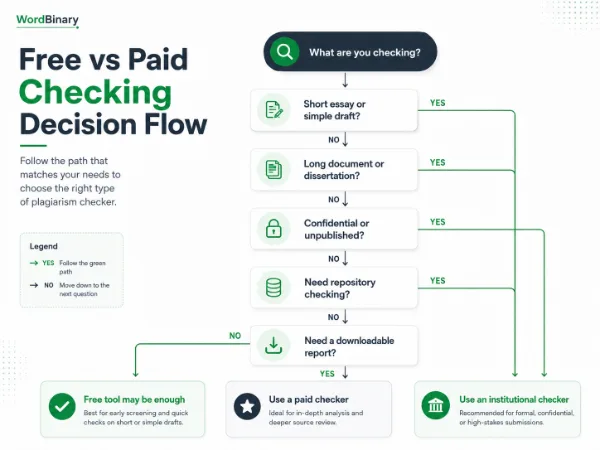
When Is a Free Checker Enough?
A free checker may be sufficient when:
- you are reviewing a short, low-risk draft;
- you want to find an accidentally copied sentence;
- the relevant sources are publicly accessible;
- you need an early-stage warning rather than formal evidence;
- you are checking a blog post or general web content;
- the tool provides enough source information to make revisions.
It may not be enough when:
- the document is a dissertation or thesis;
- the work contains confidential or unpublished material;
- an institution requires a formal report;
- comparison with student repositories matters;
- the document is long or multilingual;
- detailed exclusions and source analysis are required;
- the result will support a high-stakes academic or professional decision.
How WordBinary’s Free Access Works
Students should not confuse WordBinary’s individual AI trial with free individual plagiarism checking.
WordBinary offers free plagiarism checks to institutions only. Individual account holders receive two free AI checks, not two free plagiarism checks.
Individual users who need plagiarism analysis should review the available Pricing options. WordBinary provides credit-based individual access and separately approved institutional workflows, with allowances and permissions depending on the selected account and check configuration.
This distinction should be made clear wherever WordBinary is described as offering a free trial. The individual trial supports AI checking, while institutional plagiarism access is handled separately.
What to Look for When Comparing Paid or Institutional Tools
When free access is no longer sufficient, do not compare services only by the percentage they return.
Evaluate the following criteria:
Source coverage
Ask which sources the system can search, including publicly available websites, publications and authorised repositories.
Report detail
Look for highlighted passages, matched sources, source contribution, exclusions and downloadable evidence.
Privacy and retention
Review how documents are stored, whether they enter a repository and how they can be deleted.
Document limits
Check supported file formats, word limits, file sizes and processing restrictions.
Language support
Confirm whether the tool can analyse the language of the submitted document and whether the quality of source matching varies by language.
Access model
Some systems are primarily available through universities. Others support direct individual access.
Students comparing direct-access options can review WordBinary as a Turnitin alternative. WordBinary and Turnitin are independent systems with different databases, algorithms, account structures and reporting workflows, so identical results should not be expected.
Intended use
A tool suitable for informal draft checking may not be appropriate for disciplinary review, journal screening or institutional repository comparison.
The right service depends on the decision the report is expected to support.
Final Checklist Before Submitting an Assignment
Before submission, ask:
- Have I cited every borrowed idea that requires acknowledgement?
- Are direct quotations clearly marked?
- Have I paraphrased from understanding rather than by replacing words?
- Does every reference exist and support the claim attached to it?
- Have I reviewed the highlighted matches rather than only the percentage?
- Is any substantial overlap concentrated in the main analysis?
- Have I followed my institution’s rules on AI use?
- Have I checked whether AI assistance must be disclosed?
- Am I authorised to upload this document to an external platform?
- Have I kept my drafts, notes and version history?
- Have I proofread the final file after making changes?
Further guidance on similarity reports, AI detection, academic integrity and writing review is available through WordBinary’s Resources centre.
Conclusion
A free plagiarism checker for students can be a useful first line of review, particularly for obvious copied wording, missing source notes and overly close paraphrasing. Its value lies in showing where to look, not in declaring a document safe.
The strongest students do not chase a perfect percentage. They inspect the sources, understand why each passage matched and correct the underlying citation or writing problem.
A free result may be enough for a short, early-stage draft. Longer assignments, dissertations, research papers and formal institutional workflows may require deeper source coverage, better privacy controls and a report that explains the evidence behind the score.
WordBinary supports separate plagiarism, AI and grammar workflows so that each question can be reviewed on its own terms. Students can explore the available reports, read the academic-integrity resources and choose the level of checking that fits the document rather than relying on a single automated number.