AI detector
Assesses whether writing contains patterns associated with AI-generated text.
AI Writing Detection and Review
Check writing for patterns associated with AI-generated or AI-assisted text using WordBinary's AI detector. Review an overall AI probability, inspect sentence-level signals on full-document scans and download a structured PDF report for closer review.
WordBinary is designed for students, teachers, researchers, universities, editors and organisations that need more than a simple AI percentage.
Paste 80-400 words for a quick AI probability without registration. Two completed checks are available per rolling 24-hour period. The quick checker does not create a PDF report or retain the submitted text.
An AI detector analyses writing for statistical, linguistic and structural patterns associated with text produced by generative AI systems. Unlike plagiarism checking, which searches for textual overlap, AI detection examines characteristics of the writing itself.
These characteristics can include predictability, sentence construction, lexical choice, consistency and other signals learned during model training. An AI detector is therefore a classification and review tool, not an authorship-verification system.
The terms AI detector and AI checker normally describe the same broad task. WordBinary supports quick pasted-text screening and full-document review through one AI detection workflow.
Assesses whether writing contains patterns associated with AI-generated text.
A common alternative term for the same pattern-based review task.
Adds sentence-level signals and a downloadable report to the document result.
Generative writing is produced by many platforms, not one system. A 2026 WordBinary evaluation tested known AI output from Claude, Cohere, DeepSeek, Gemini, Mistral, OpenAI and OpenRouter, including normal and humanised output.
The reported findings apply to the tested model version, named model groups, supplied dataset and evaluation conditions. They should not be extended into a universal guarantee for every future model or writing condition.
AI detection is most useful when the user understands each stage of the review.
Use the quick checker for 80-400 pasted words or upload an eligible full document through your account.
WordBinary evaluates writing patterns and automatically routes supported languages to the appropriate detection workflow.
Treat the percentage as a model output requiring context, not as the literal percentage typed by an AI system.
Eligible full-document checks identify passages contributing more strongly to the analysis.
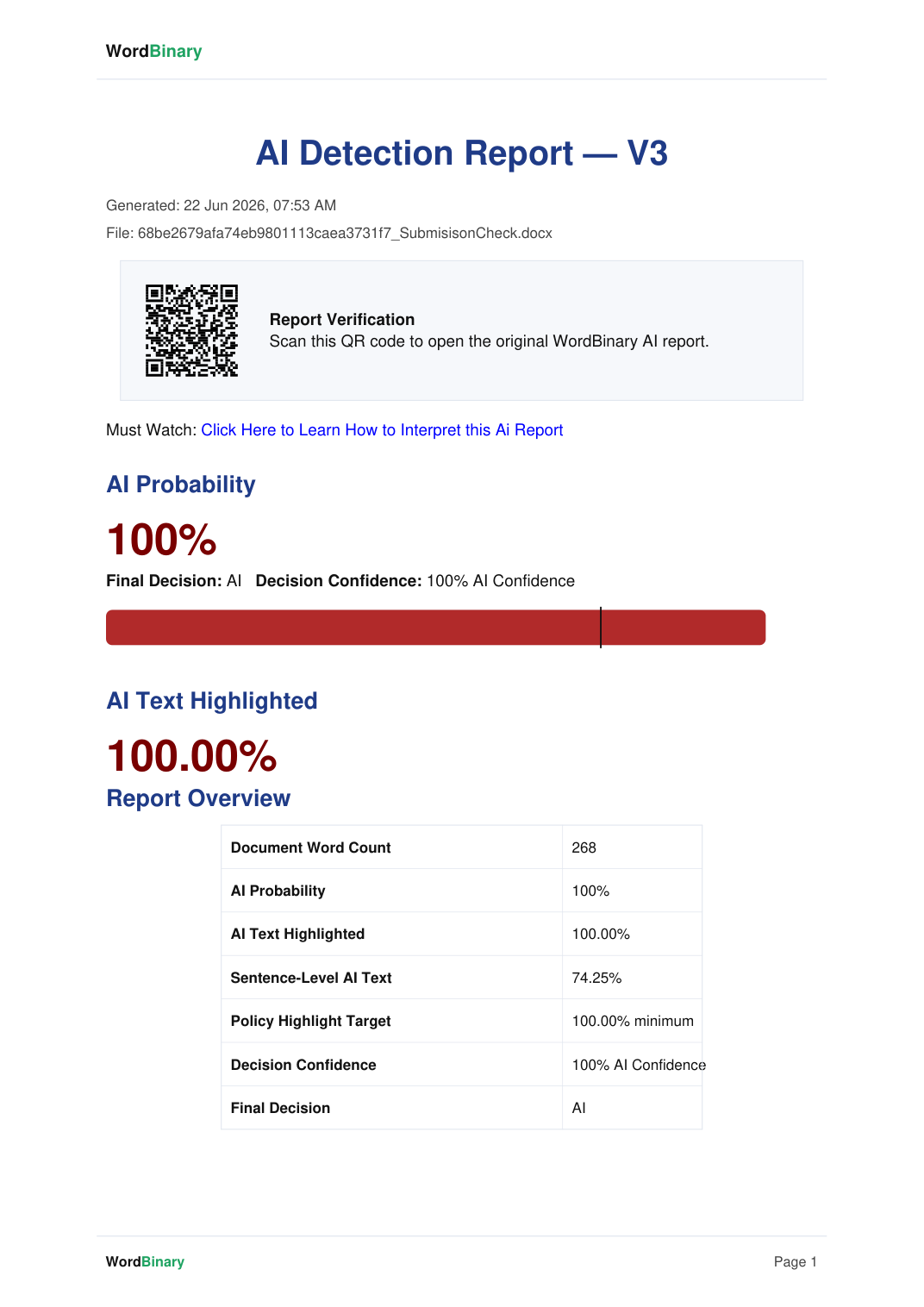
Save an eligible full-document result as a PDF for revision, record keeping or authorised review.
Many free AI checkers stop at one percentage. WordBinary's complete workflow adds context that can be inspected and retained.
Review the document-level result before examining individual passages.
Locate passages associated more strongly with AI-writing signals.
Understand the limitations of the output and where human judgement remains necessary.
Review highlighted passages alongside surrounding writing.
Keep a structured report that can be revisited or shared where appropriate.
An AI score is a model-generated indicator. A high probability means the detector found strong patterns associated with AI-generated writing. It does not independently establish who wrote the document, which platform was used, whether a policy was broken or whether misconduct occurred.
Different detectors can assign different percentages because their models, thresholds and scoring systems differ. A responsible review considers the overall score, highlighted passages, surrounding paragraphs, drafts, version history, sources, the writer's normal style and the applicable policy.
WordBinary is designed around academic and structured document review. Students and researchers can use it before submission to identify passages that deserve closer inspection.
A useful review asks whether highlighted passages are generic or repetitive, whether claims are supported, whether style changes unexpectedly, whether citations are correct, whether AI use was permitted and whether drafts support the writing process.
Use the report for genuine revision, citation review and evidence-led pre-submission checking rather than mechanically rewriting to lower a score.
Use AI signals to identify passages for closer review alongside policy, drafts, writing history and communication with the writer.
Review manuscripts and reports where publishers or institutions have policies concerning generative AI.
Use approved account structures, permissions and human-review procedures within a configured academic workflow.
WordBinary supports English, Arabic, Chinese, Czech, Danish, Dutch, Finnish, French, German, Greek, Hindi, Hungarian, Indonesian, Italian, Japanese, Korean, Malay, Norwegian, Polish, Portuguese, Romanian, Russian, Spanish, Swedish, Turkish, Ukrainian and Vietnamese.
English text uses the established English workflow, while supported non-English text uses a separately trained multilingual model. The dominant language is detected automatically. Translated, mixed-language and heavily edited text still require careful interpretation.
Full-document AI processing identifies reference and bibliography sections before scoring and sentence highlighting. This focuses the review on substantive prose rather than predictable bibliography formatting.
Users should still inspect extraction and report context carefully for unusual layouts, scanned documents and mixed-language files. This reference handling applies to the full-document workflow, not to a short pasted-text check.
Published evaluations help users understand the dataset, measures and limitations behind an AI detection result.
The current study reports 9,000 AI-generated samples from seven platform groups and 2,000 pre-2015 human academic samples. All samples were correctly classified within that supplied dataset.
A separate Zenodo-published comparison examined eight platforms and showed that confidence percentages differ substantially between systems.
WordBinary also publishes evidence about detection and false-positive behaviour across its supported multilingual model.
These results describe specific datasets and model versions. They are not a promise of universal accuracy.
Yes. False positives remain possible. Formal, translated, formulaic or highly regular human writing can sometimes resemble generated prose, while substantially revised AI text can avoid some signals.
If human writing receives a high score, inspect the highlighted passages, compare earlier drafts, review source notes, confirm any language tools used, check version history and follow the relevant institutional procedure.
| Feature | Quick AI Check | Full Document Check |
|---|---|---|
| Account required | No | Yes |
| Text length | 80-400 words | Current account limit |
| AI probability | Yes | Yes |
| Sentence-level review | No | Yes |
| Downloadable PDF | No | Yes |
| Detailed academic workflow | Limited | Yes |
A document can contain AI-written material without plagiarism, contain plagiarism while appearing human-written, or require language improvement without major AI or similarity concerns.
Examines writing for patterns associated with generative AI.
Looks for similarity and matching material across available sources.
Identifies grammar, punctuation, spelling and clarity concerns.
WordBinary provides direct individual access as well as approved institutional workflows. Turnitin remains primarily centred on institution-managed submission and review.
The platforms use different models, thresholds and report systems, so scores are not interchangeable. WordBinary is independent and is not owned, sponsored, approved or endorsed by Turnitin.
AI detection supports review; it does not provide an automatic verdict. High-stakes academic, employment or disciplinary decisions require authorised human judgement and supporting evidence.
Upload only material you are authorised to share. General uploaded source files are removed after seven days, while report retention depends on account type and workflow. Review the current privacy policy for complete terms.
The report preserves the result and supporting evidence for contextual review. Findings depend on the submitted document, selected workflow and available comparison material.
Continue Learning
Understand AI scores, false positives, reports, multilingual detection and how AI-writing signals should be reviewed.
An AI detector is a classification tool that analyses writing for patterns associated with AI-generated text. Its result is a review signal, not proof of authorship.
Usually, yes. Both terms commonly describe software that estimates whether writing resembles AI-generated text.
Yes. Visitors can check 80-400 pasted words twice in a rolling 24-hour period without creating an account.
The published 2026 evaluation includes tested OpenAI model output. Results apply to the named dataset and tested model version.
The published evaluation includes Claude output, including normal and humanised samples, within the tested dataset.
The published evaluation includes Gemini output within the tested dataset.
The published evaluation includes DeepSeek Chat and DeepSeek Reasoner output within the tested dataset.
Yes. Essays and other supported academic documents can be reviewed, subject to account and document limits.
Yes. Eligible research papers can be uploaded for full-document analysis, but results still require context and human review.
Eligible full-document checks include sentence-level signals. The free paste-text checker provides only an overall AI probability.
Yes. Eligible full-document AI checks provide a downloadable PDF report.
It is a model-generated probability signal. It is not the literal percentage of words proven to have been written by AI.
Yes. False positives are possible, especially with formal, formulaic, translated or highly regular writing.
Yes. False negatives are possible, particularly with heavily edited, translated, mixed-authorship or short text.
No. Scores should be reviewed with drafts, writing history, sources, policy and other relevant evidence.
WordBinary publishes dated evaluations with dataset-specific results and limitations. No result should be interpreted as a guarantee for every future document.
WordBinary AI detection supports English and 26 additional languages, for a total of 27.
No. Supported non-English text is routed to a separately trained multilingual model.
Yes. Plagiarism checking is a separate analysis that reports similarity and matched sources.
No. WordBinary is an independent platform and is not owned, sponsored, approved or endorsed by Turnitin.
Eligible full-document checks provide downloadable reports. The free pasted-text checker does not create a PDF.
Run a quick pasted-text check or upload a full document for sentence-level review and an eligible PDF report.