Academic Integrity Software for Individuals and Institutions
AI and Plagiarism Checker with Grammar Review and PDF Reports
WordBinary is academic integrity software that brings AI-writing analysis, source-similarity checking and grammar review into one document workflow. Review AI probability and similarity as separate results, inspect sentence-level and source-level evidence, and download a clear PDF report for revision, record keeping or human review.
Individuals can access WordBinary directly, while approved institutions can use structured teacher, supervisor and connected student workflows with configured permissions and submission controls.
Direct access for individual usersStudents, researchers and direct users can start from available plans.
Approved institutional account workflowsTeacher, supervisor and connected student structures are available where configured.
Separate AI and similarity resultsAI probability and source similarity are presented independently.
Sentence-level and source-level review informationReports help users inspect the evidence behind headline results.
Downloadable reports for eligible checksPDF reports support revision, record keeping and authorised review.
Defined document and report retention periodsRetention depends on upload area, account type and repository configuration.
Responsible interpretation guidanceResults support human review rather than automatic academic judgements.
Key features
Separate AI probability and similarity results
Sentence-level AI-writing signals
Highlighted matches and identified sources
Grammar, punctuation and clarity suggestions
Downloadable PDF reports
Individual and institutional workflows
What WordBinary Checks in One Document Review
WordBinary combines three related but distinct forms of document analysis. Each check answers a different question and produces a separate result. AI probability, similarity percentage and grammar findings should not be merged into a single academic integrity score.
AI-writing analysis
WordBinary’s AI Detector reviews writing patterns that may resemble AI-generated or AI-assisted text. The report can include a document-level AI probability, sentence-level review signals, confidence information and guidance for interpreting the result.
AI detection estimates writing patterns. It cannot identify the specific AI tool that may have been used, establish who wrote the document or prove academic misconduct. The result is intended to support careful review alongside drafts, writing history and other available evidence.
Plagiarism and similarity checking
The WordBinary Plagiarism Checker compares submitted text with available online, publication and authorised repository content to identify textual overlap. The resulting similarity report can present matched passages, source links, source contribution and an overall similarity percentage.
A similarity score does not automatically mean that plagiarism has occurred. Quotations, references, standard terminology, titles and properly cited material can all contribute to textual overlap. Users should examine the matched text and source context before deciding whether a passage needs revision, quotation marks, attribution or citation correction.
Grammar and writing clarity
The WordBinary Grammar Checker reviews grammar, punctuation, spelling, sentence construction and clarity. Users can examine individual suggestions, apply the corrections they consider appropriate and download an updated document where that option is available.
Grammar checking improves language and readability. It does not determine whether writing is original or whether it was produced by a human or an AI system. The writer remains responsible for reviewing every suggested change and preserving the intended meaning.
Grammar, punctuation, spelling and clarity suggestions
Whether content is human-written or original
How WordBinary's AI and Plagiarism Checker Works
WordBinary follows a four-step document review process: upload a supported document, choose the required checks, examine each result separately and download the available report.
1
Upload a supported document
Create or access your WordBinary account and upload the document you want to review. Available file types, document limits and processing options depend on the selected plan, account structure and check configuration.
Before uploading academic or confidential material, users should review their institution’s rules and the WordBinary privacy and retention information.
2
Select the checks you need
Choose AI detection, plagiarism checking, grammar review or an eligible combined workflow. Each check performs a different analysis, and account permissions determine which options and scan modes are available.
Institutional users may receive settings from an authorised teacher, supervisor or administrator account.
3
Review the findings
Examine the AI probability, sentence-level signals, similarity percentage, highlighted overlap, matched sources and grammar suggestions that apply to the selected checks.
Do not rely only on the largest percentage displayed in the report. The location, concentration, source and context of each finding are often more important than the headline number.
4
Download the available report
Eligible paid checks provide downloadable reports containing the displayed results and supporting review information. Reports can assist with revision, record keeping, supervisor discussions, editorial review or authorised institutional assessment.
Report verification and repository-related features appear only where they have been enabled for the relevant account.
Understand AI Probability, Similarity and Grammar Separately
An AI probability is not a plagiarism score, and a similarity percentage is not a grammar result. WordBinary presents these findings separately because they describe different aspects of a document.
Result
What it measures
What it does not establish
AI probability
The extent to which writing patterns resemble AI-generated text
Authorship, use of a particular AI model or academic misconduct
Similarity percentage
Textual overlap with available sources and repository content
Plagiarism without reviewing citations, quotations and context
Grammar findings
Possible grammar, punctuation, spelling and clarity concerns
Originality or whether the writing is human-generated
Sentence signals
Passages that contributed to the AI-writing analysis
That every highlighted sentence was produced by AI
Matched sources
Sources containing similar or overlapping text
That the writer copied from the listed source intentionally
What an AI probability means
An AI probability is a model-based assessment of writing patterns. A higher result indicates that the analysed text contains more patterns associated with the model’s AI-generated category. It does not show the percentage of words definitely written by AI and should not be interpreted as proof of authorship. Sentence-level signals help users locate the passages that may deserve closer examination. The overall result should be considered alongside the writing style, drafts, references, revision history and purpose of the document.
What a similarity percentage means
A similarity percentage shows how much submitted text overlaps with material found in the available comparison sources. A moderate or high similarity percentage can include correctly quoted text and references, while a lower percentage can still contain an important uncited passage. The matched text, source contribution and citation context therefore matter more than an assumed universal “safe” percentage.
What grammar findings mean
Grammar findings identify possible language concerns, including punctuation, spelling, sentence construction and clarity. The number of suggestions is not a measure of academic integrity or authorship. Users should accept only the corrections that improve the document without changing its intended meaning, evidence or argument.
Results support human review
WordBinary reports provide decision-support information. AI-writing signals and textual similarity should not be used as automatic disciplinary conclusions. Academic, editorial and administrative decisions require appropriate policy, contextual evidence and authorised human judgement.
Evidence Behind WordBinary's AI Detection
WordBinary publishes research and model evaluations to help users understand how AI detection results should be interpreted. These studies report dataset size, evaluation measures, results and stated limitations rather than presenting accuracy as an unsupported universal claim.
A three-layer AI detection workflow
The WordBinary AI detection workflow provides three connected levels of information: document-level analysis with an overall AI probability for the analysed text, sentence-level review signals that help users locate passages contributing to the result, and report-level interpretation explaining confidence, limitations and the role of human review. These layers are designed to make the report more interpretable than a single unexplained percentage. The displayed output remains a model-based assessment and should be considered with supporting evidence.
Evaluation across 11,000 text samples
A 2026 first-party WordBinary evaluation tested the latest model on 11,000 text samples. The dataset included 9,000 AI-generated texts and 2,000 pre-2015 human academic paper samples. Within that supplied dataset, all 9,000 AI-generated samples were identified as AI and all 2,000 human academic samples were classified as human. The AI-generated set represented multiple model providers and included normal and humanised output, while the human set covered several academic subject areas. These results apply to the tested model version, dataset and evaluation conditions. They should not be interpreted as a promise that every future document will be classified correctly.
A separate Zenodo-published study compared eight AI detection platforms using the same set of 125 documents, including 75 human-written and 50 AI-generated documents. The study examined confidence scores, calibration, human-text conservatism and separation between the two document groups. WordBinary ranked third in its composite analysis and recorded a 95.69% mean AI confidence score on AI-generated documents and a 0.01% mean AI score on human-written documents. These are confidence results within the study’s dataset. A mean AI confidence of 95.69% should not be presented as a universal 95.69% accuracy rate.
AI detection is an evolving field. Performance can change across languages, disciplines, document lengths, heavily edited AI content, paraphrased text, translated writing and mixed human-AI documents. Formal human writing can sometimes resemble AI-generated prose, while edited AI text may avoid some detection signals. For this reason, WordBinary treats AI detection as analytical assistance rather than definitive proof.
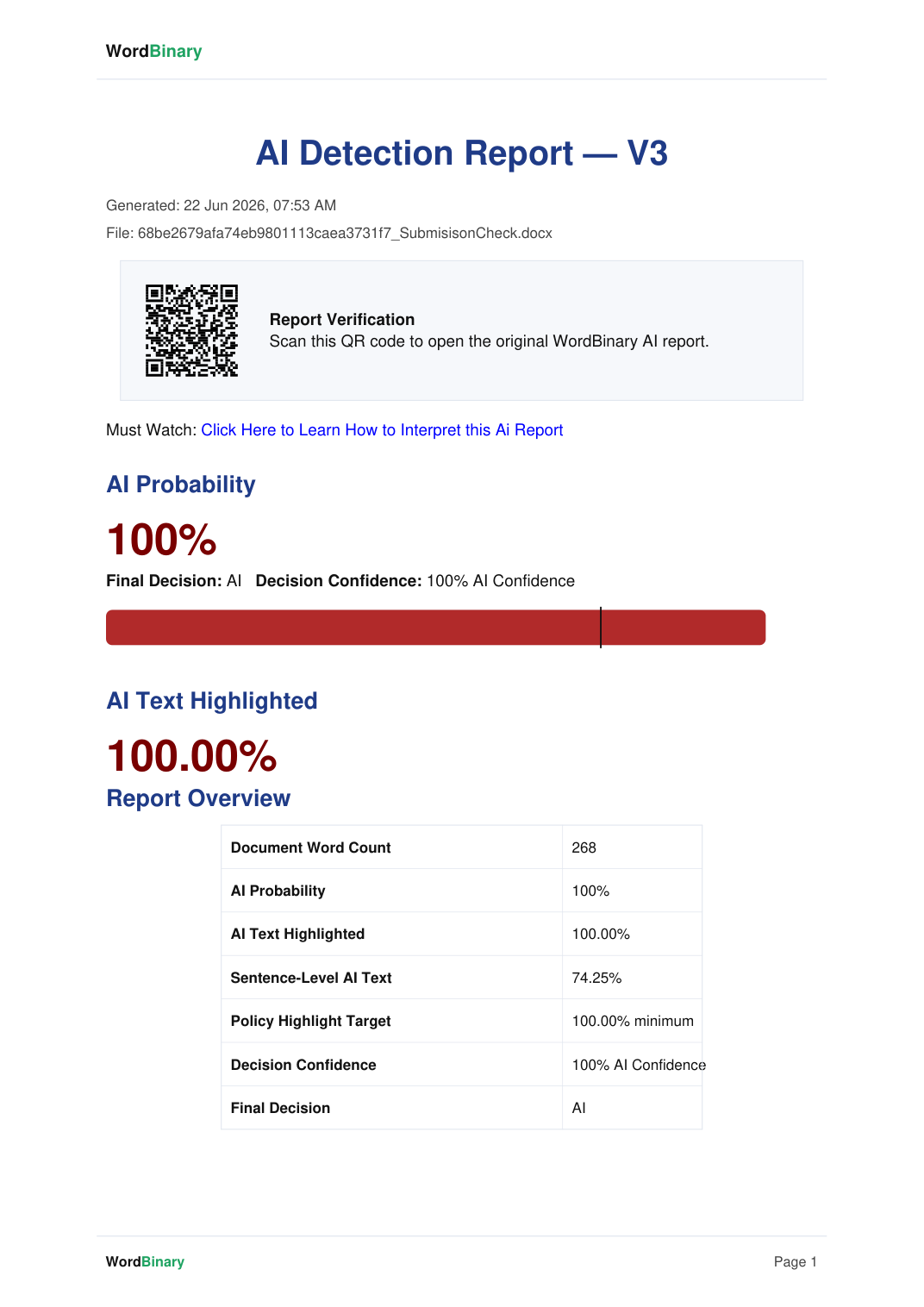
See a WordBinary report example
This example shows the type of evidence available for review. Scores and findings depend on the submitted document, selected workflow, source availability and account configuration.
Example WordBinary AI detection PDF. Report verification appears only for accounts where it is enabled.
Academic Integrity Software for Different Workflows
Available permissions, report retention and repository options depend on account type and configured workflow.
Students and individual users
Students and direct users can review essays, assignments, reports, dissertations and other supported documents before submission. The combined workflow can help users identify AI-writing signals, source overlap and language concerns without moving between unrelated platforms. Students should use the results to support genuine revision and responsible academic practice. The applicable institutional policy should always take priority over general guidance provided by a software platform.
Researchers and academic authors
Researchers can use WordBinary to examine manuscripts, working papers, literature reviews, research proposals and other academic documents before journal, conference or institutional review. Similarity findings may help identify passages requiring citation or quotation review, while grammar suggestions can support readability and presentation. AI detection remains an additional writing signal and should not replace authorship evidence, research records or editorial judgement.
Teachers and supervisors
Approved teacher and supervisor workflows can support document collection, report access and connected student accounts within configured permissions. A report may help an authorised reviewer identify passages that deserve discussion, but it should not be treated as a substitute for disciplinary procedures, student communication, institutional policy or examination of the writer’s drafts and sources.
Universities and institutions
Approved institutional workflows can include teacher, supervisor and connected student structures, submission controls, repository-enabled comparison, report retention settings, API access or LTI 1.3 onboarding where configured. Institutional availability, document limits and permissions are established during onboarding. Repository content is used only within authorised configurations.
Publishers, editors and professional teams
Publishers, editors, agencies and content teams can use WordBinary to review content authenticity, textual overlap and language quality before publication or delivery. The platform can support screening and editorial review, but the final assessment should consider the document’s purpose, authorship agreement, citation requirements and publication policy.
Privacy, File Retention and Report Access
WordBinary uses defined retention periods for uploaded documents and generated reports. Retention depends on the upload area, account type, repository configuration and institutional permissions.
Content type
Retention position
Files in the general upload area
Removed automatically after seven days
Standard user reports
Retained for 60 days
Eligible institutional reports
Retained for up to two years
Authorised repository submissions
Remain available until deletion is requested by authorised institutional personnel
Eligible reports may be removed earlier following an authorised support request. A request involving an institutional account, connected user or repository record must come from a person with the appropriate authority.
Users should download reports they need to retain before the applicable retention period ends. They should also avoid uploading material that they are not authorised to share with a third-party document review service.
Retention information does not replace the complete legal policy. Users and institutions should review the current WordBinary Privacy Policy and contact WordBinary Support with questions about document handling, deletion or institutional configurations.
WordBinary, Turnitin and Grammarly address overlapping aspects of writing and document review, but their primary workflows and access models differ.
Platform
Primary workflow
Typical access
WordBinary
AI detection, plagiarism checking and grammar review with downloadable reports
Direct individual access and approved institutional workflows
Turnitin
Institution-managed submission and academic integrity review
Primarily through participating educational institutions
Grammarly
Grammar, style and general writing improvement
Individual and organisational writing accounts
WordBinary is designed for users who want direct access to separate AI and similarity results, grammar support and downloadable reports within one workspace. It can also support approved teacher, supervisor and institutional account structures.
Turnitin remains centred on institution-managed submission and academic integrity workflows. Grammarly is primarily designed around writing assistance, grammar, clarity and style.
The platforms use different algorithms, databases, thresholds, report formats and account systems. The same document may therefore receive different results. WordBinary does not promise score equivalence with another platform.
WordBinary is an independent platform and is not owned, approved, sponsored or endorsed by Turnitin or Grammarly. Users comparing WordBinary as a direct-access Turnitin alternative should consider source coverage, privacy, report requirements, institutional integrations, pricing and the intended review context.
Comparison reviewed in July 2026. Features and access models may change.
WordBinary is an academic integrity software platform that combines AI-writing analysis, plagiarism and similarity checking, grammar review and downloadable reports. It supports direct individual access as well as approved teacher, supervisor and institutional document-review workflows.
Can WordBinary check AI writing and plagiarism in the same workflow?
Yes. Eligible WordBinary accounts can run AI detection, plagiarism checking and grammar review through a combined workflow. The platform presents the results separately because AI probability, textual similarity and grammar findings measure different aspects of a document.
Is an AI probability the same as a similarity score?
No. An AI probability estimates whether writing patterns resemble AI-generated text. A similarity score measures textual overlap with available sources. A document can receive a high AI probability and low similarity, or low AI probability and high similarity.
Can WordBinary prove that academic misconduct occurred?
No. WordBinary provides evidence for review, not an automatic misconduct verdict. AI-writing signals and textual overlap should be assessed alongside citations, drafts, writing history, institutional policy, student explanations and other relevant evidence.
What information can appear in a WordBinary report?
Depending on the selected check and account permissions, a report can include AI probability, confidence information, sentence-level signals, similarity percentage, highlighted overlap, matched sources, source contribution, citation indicators, grammar suggestions and interpretation guidance.
How long does WordBinary keep uploaded documents and reports?
Files in the general upload area are removed automatically after seven days. Standard user reports are retained for 60 days. Eligible institutional reports can be retained for up to two years. Authorised repository submissions follow the applicable institutional deletion process.
Can individuals and institutions use WordBinary?
Yes. Individuals can register and access available plans directly. Approved institutions can use configured teacher, supervisor and connected student workflows, with submission limits, permissions, retention settings, repository options and integrations determined during onboarding.
Will WordBinary produce the same score as Turnitin?
Not necessarily. WordBinary and Turnitin use different source coverage, algorithms, thresholds and reporting systems. Their results are not directly interchangeable, and WordBinary does not promise that a document will receive an identical AI or similarity score on another platform.
About WordBinary
WordBinary is academic integrity technology developed by Concepts and Context, a business firm registered in Ayodhya, Uttar Pradesh, India. The platform was founded by Mohammad Zeeshan to support responsible AI detection, similarity review, grammar checking and evidence-led document assessment.
WordBinary develops tools for individuals, students, researchers, teachers, supervisors, institutions, publishers and professional teams. Its reports are designed to support informed human review rather than automatic judgements about authorship or academic misconduct.
Check AI-writing signals, source similarity and grammar in one workspace
Upload a supported document, select the checks you need and review each result in context. WordBinary helps you examine AI probability, matched sources and writing-quality concerns before submission, publication, assessment or professional delivery.
Direct access for individual usersStudents, researchers and direct users can start from available plans.
Approved institutional account workflowsTeacher, supervisor and connected student structures are available where configured.
Separate AI and similarity resultsAI probability and source similarity are presented independently.
Sentence-level and source-level review informationReports help users inspect the evidence behind headline results.
Downloadable reports for eligible checksPDF reports support revision, record keeping and authorised review.
Defined document and report retention periodsRetention depends on upload area, account type and repository configuration.
Responsible interpretation guidanceResults support human review rather than automatic academic judgements.