WordBinary Blog
Similarity Checker vs Plagiarism Checker: What Is the Real Difference?
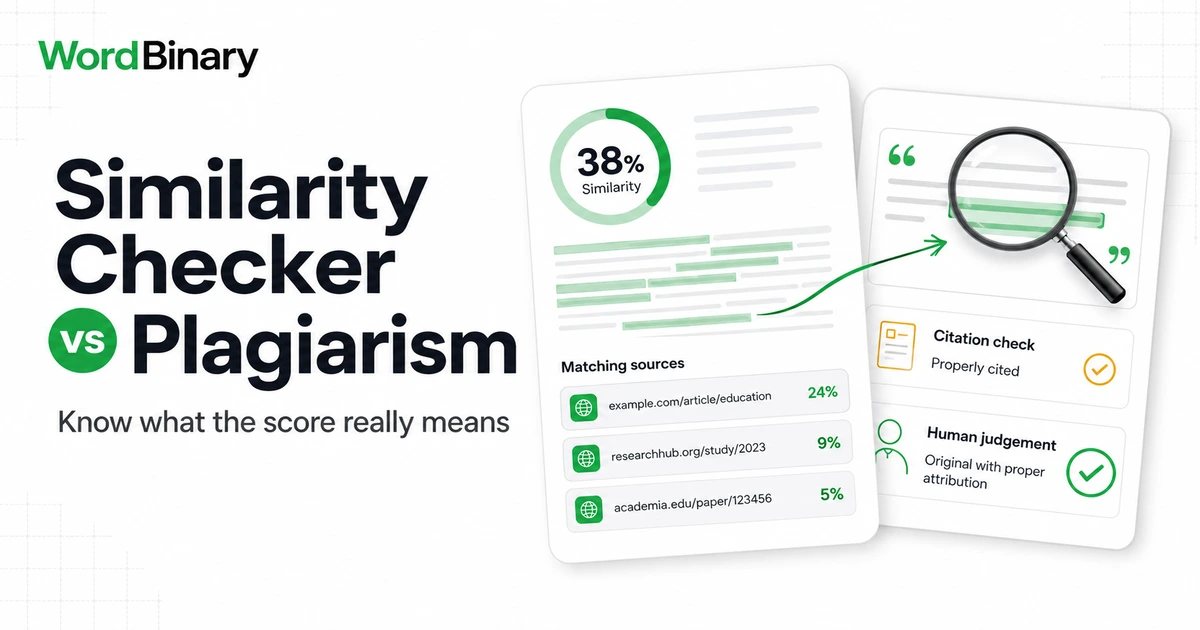
When comparing a similarity checker vs plagiarism checker for an essay, thesis, research paper or business document, the difference may not be immediately clear. Some platforms use the terms interchangeably, while others present them as separate services. This leaves users wondering whether they need one tool or both.
The short answer is that most plagiarism checkers are technically similarity checkers. They compare submitted text with available sources and identify matching or closely overlapping passages. The software can show where matches occur, which sources appear to contain them and how much of the document overlaps with material in its comparison database.
What it cannot do by itself is decide whether the writer has committed plagiarism.
Plagiarism depends on context. A correctly quoted paragraph, a title appearing in the reference list and an unattributed copied passage may all produce text matches. However, only the last example is likely to present a serious plagiarism concern. Understanding this distinction is essential when interpreting any similarity report.
Key Takeaways
- A similarity checker identifies matching or overlapping text.
- “Plagiarism checker” is commonly used as a user-friendly product name for similarity-detection software.
- A similarity percentage is not automatically a plagiarism percentage.
- Correct quotations, references, standard terminology and document templates can increase similarity.
- A low score can still contain one serious unattributed passage.
- The source, location, length and treatment of each match matter more than the total score alone.
- Software should support human review, not replace academic or professional judgement.
What Does a Similarity Checker Do?
A similarity checker compares the text in a submitted document against sources accessible to the system. Depending on the platform, those sources may include publicly accessible webpages, publications, institutional repositories, licensed databases or previously submitted documents.
When overlapping text is found, the tool typically produces a similarity report containing:
- An overall similarity percentage
- Highlighted matching passages
- Links or references to possible sources
- A percentage or word contribution for individual sources
- Filters for quotations, references or short matches
- A downloadable or shareable report
The report answers a factual question:
How much of this document resembles text found in the sources searched by this system?
It does not conclusively answer:
Has the writer plagiarised?
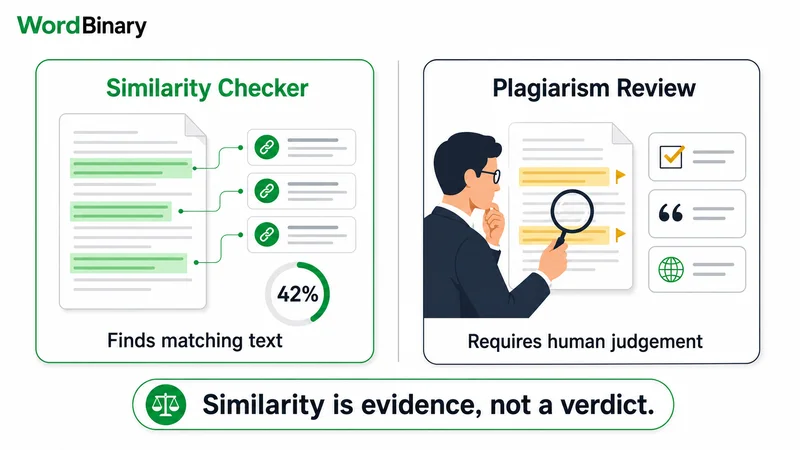
That limitation is not merely theoretical. Turnitin’s own guidance says its similarity score represents the percentage of text matching sources in its database and should be used within a review process, rather than treated as a plagiarism determination. It also acknowledges that quotations and references can appear as matches. WordBinary guidance on understanding similarity scores
A similarity checker is therefore best understood as an evidence-finding tool. It directs the reviewer towards passages that may need attention.
What a similarity checker may miss
A similarity report is influenced by what the system can search. A document may receive no match against a source that is private, offline, newly published, restricted or absent from the tool’s database.
Similarity software may also fail to identify:
- An idea taken from an unpublished conversation
- A translated passage when cross-language matching is unavailable
- Heavily disguised copying
- Appropriation of a unique research method without repeated wording
- An image, design or data structure copied without acknowledgement
- Contract cheating in which someone writes an original document for another person
This matters because plagiarism can concern ideas, processes, results and other intellectual contributions, not only identical sentences. The US Office of Research Integrity, for example, defines research plagiarism as appropriating another person’s ideas, processes, results or words without appropriate credit. Office of Research Integrity definition
A zero per cent similarity score should therefore be read as “no matching text found under this check”, not “originality proven”.
What Does a Plagiarism Checker Do?
In everyday use, a plagiarism checker usually performs the same core comparison as a similarity checker. It scans text, finds overlap and produces a report. The difference is often one of naming and user expectation rather than a completely different technology.
The phrase “plagiarism checker” suggests that the system can check whether plagiarism has occurred. In reality, the output is normally evidence of textual similarity that must be interpreted.
This distinction becomes clearer when plagiarism itself is defined. The University of Oxford describes plagiarism as presenting work or ideas from another source as one’s own by incorporating them without full acknowledgement.
That definition requires questions a text-matching system cannot fully answer:
- Was the source acknowledged?
- Was a direct quotation clearly marked?
- Did the writer have permission to reuse the material?
- Was the material common knowledge?
- Does the applicable citation style require a reference here?
- Is this reused work governed by a self-plagiarism or text-recycling policy?
- Was the overlap accidental, careless or intentional?
- Does the institution consider the conduct an academic-integrity breach?
A plagiarism similarity checker can organise the evidence needed to investigate those questions. The final conclusion must come from the writer, teacher, editor, institution or authorised reviewer applying the relevant rules.
Similarity Checker vs Plagiarism Checker: Direct Comparison
| Point of comparison | Similarity checker | Plagiarism checker |
|---|---|---|
| Core function | Finds text that matches or resembles accessible sources | Usually uses the same type of text-matching process |
| Main output | Similarity score, highlights and source matches | Commonly a similarity report labelled for plagiarism review |
| Question answered | “Where does this document overlap with other text?” | Often marketed as answering “Is this plagiarised?” |
| Can it prove plagiarism? | No | No, not without contextual review |
| Can correctly cited text be matched? | Yes | Yes |
| Can it detect every form of plagiarism? | No | No |
| Best use | Finding overlap and reviewing source use | Pre-submission checks and academic-integrity investigation support |
| Human judgement required? | Yes | Yes |
| Score interpretation | Percentage of detected matching text | Should not be treated automatically as a plagiarism percentage |
For most users, the better question is not which label appears on the product. It is whether the system produces a transparent, useful similarity report.
Why Similarity Is Not the Same as Plagiarism
Two documents can have the same similarity score while presenting completely different levels of concern. The total percentage does not explain how the matched material was used.
Legitimate material can increase a similarity score
A report may highlight text that has been used properly, including:
- Direct quotations enclosed in quotation marks and cited
- Titles of books, papers or legislation in a reference list
- Standard technical expressions
- Names of institutions, instruments or established theories
- Required declarations or assignment cover-page wording
- Research questions supplied by a university
- Commonly used descriptions of a methodology
- Repeated wording from an approved document template
Such matches should be reviewed, but they are not automatically evidence of misconduct.
Indian researchers should also be aware of the UGC’s 2018 plagiarism regulations. The regulations state that certain material should be excluded from similarity checks for plagiarism, including properly attributed quotations, references, bibliographies, contents pages, prefaces, acknowledgements, generic terms, laws, standard symbols and standard equations.
This is one reason a raw report percentage should not be applied mechanically. The settings used to generate the report and the material included in its calculation can materially change the result.
A low score can contain a serious match
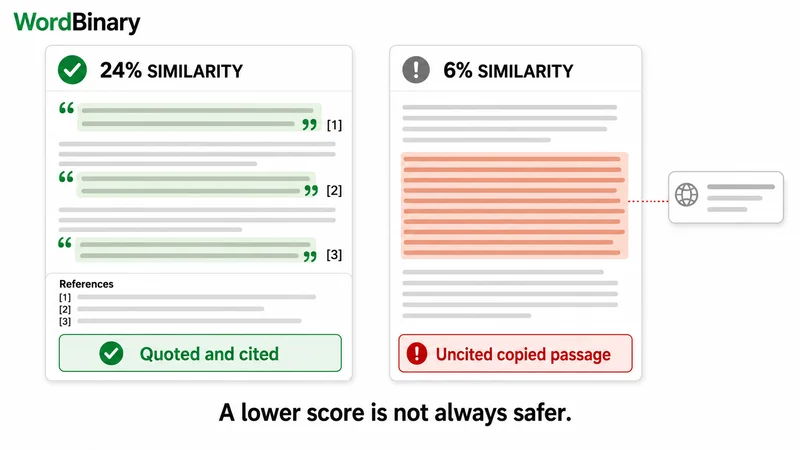
Suppose a 5,000-word research paper receives a similarity score of only 6%. Most of the paper is original, but 250 consecutive words in the literature review have been copied from one journal article without quotation marks or a citation.
The total percentage appears low. The individual match is still potentially serious because it is concentrated, substantial and unattributed.
Now consider another paper with 24% similarity. Its matches come from correctly presented participant quotations, an extensive bibliography, a standard ethics declaration and several cited definitions. The higher-scoring paper may present less concern once each match is examined.
The practical lesson is simple: match quality matters more than score colour.
What Does the Similarity Percentage Actually Mean?
A similarity percentage normally represents the proportion of submitted text that the system has associated with one or more sources. The precise calculation, source-selection rules and overlap handling vary between platforms.
Several factors can change the displayed score:
- The comparison database selected
- Whether previous student submissions are included
- Whether quotations are excluded
- Whether the bibliography is excluded
- The minimum length set for a reportable match
- Treatment of overlapping sources
- File extraction quality
- Language and translation support
- Whether a previously submitted draft is in the repository
For this reason, the same document can receive different results from different systems or from the same system under different settings. That does not necessarily mean one report is false. The tools may have searched different collections or applied different exclusions.
Is there a safe similarity percentage?
There is no universal percentage that proves a document is safe, original or plagiarised.
Universities, publishers and organisations may set their own review thresholds. Some policies also distinguish between coursework, theses, journal manuscripts, legal documents and highly standardised reports. A score considered ordinary for a quotation-heavy qualitative study may be unusual in a short reflective essay.
Where an institution has published a threshold, treat it as a trigger or policy rule within that specific context. Do not treat it as a scientific boundary between plagiarism and original writing.
The more defensible approach is to ask:
- What material produced the score?
- Was each source acknowledged?
- Are copied words shown as quotations?
- Is the paraphrasing genuinely independent?
- Does the document follow the applicable institutional policy?
How to Read a Plagiarism Similarity Report Properly
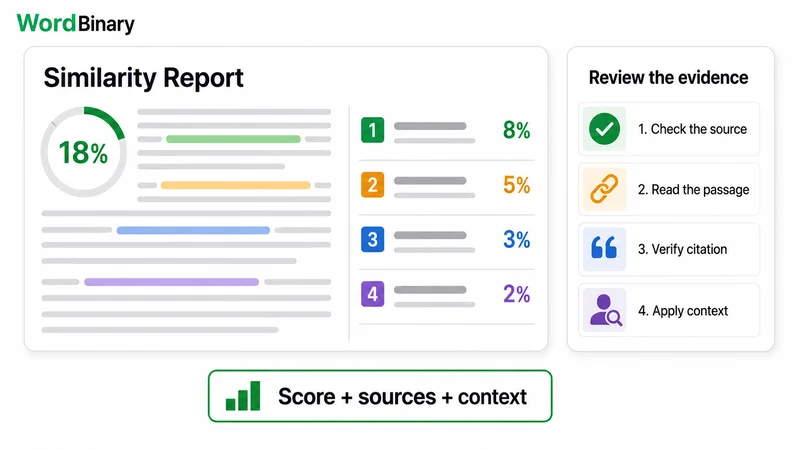
A useful report should be reviewed from the source level upwards, not from the overall percentage downwards.
1. Confirm the report settings
Before interpreting the result, check whether quotations, bibliographies and short matches were included. Also confirm whether the document was compared with webpages, publications, repositories or previous submissions.
Without this information, two percentages may not be directly comparable.
2. Review the largest individual source
Open the source contributing the greatest amount of matched text. Determine whether it represents one continuous copied passage or several small, unrelated matches.
A 10% contribution from a single source may deserve closer attention than a 10% total assembled from many titles, citations and common phrases.
3. Inspect each highlighted passage in context
Read the sentences before and after the match. A citation at the end of a paragraph may acknowledge the underlying idea, but it does not necessarily show that the preceding words were reproduced verbatim.
Ask whether the passage is:
- A properly formatted quotation
- A close paraphrase
- An uncited idea
- Standard or unavoidable wording
- A reference entry
- Reused material from the writer’s earlier work
- An accidental match with no meaningful connection
4. Compare the wording with the source
Good paraphrasing changes more than a few words. It reconstructs the explanation from the writer’s understanding while preserving the original meaning and acknowledging the source.
Replacing a handful of words with synonyms while retaining the original sentence structure may still be an overly close paraphrase. A citation does not give permission to reproduce exact language without quotation marks.
5. Decide what correction is appropriate
Different matches require different responses:
| Match type | Appropriate action |
|---|---|
| Exact words needed from a source | Add quotation marks or block formatting and a complete citation |
| Source idea expressed too closely | Rewrite from understanding and retain the citation |
| Source idea with no acknowledgement | Add the required citation |
| Reference-list or bibliography match | Confirm formatting; exclude only if permitted |
| Standard technical phrase | Usually retain, but verify whether attribution is expected |
| Reuse from an earlier document | Cite or disclose the earlier work according to the applicable policy |
| Irrelevant source association | Review for accidental wording overlap; no forced rewrite may be necessary |
6. Check the revised document again
After making genuine corrections, run a new check if the service and institutional rules permit it. Do not revise simply to force the percentage down. The goal is responsible source use, not a cosmetically lower number.
WordBinary’s Plagiarism checker is designed to support this type of review by presenting matched sources, highlighted overlap and downloadable report information.
Common Mistakes When Using Similarity Checkers
Treating every highlight as plagiarism
Highlights identify relationships between text, not misconduct. Automatically removing every highlighted phrase can make a document less accurate and harder to read.
Chasing a zero per cent score
Academic writing depends on engagement with existing knowledge. Quotations, citations, recognised terminology and references can legitimately produce matches. Zero similarity is neither necessary nor a guarantee of ethical authorship.
Using synonym replacement to lower the score
Mechanical word substitution often damages meaning while leaving the borrowed structure intact. It may also create unnatural sentences. Read the source, put it aside, explain the point independently and then check that the citation remains accurate.
Believing that a citation fixes verbatim copying
A citation tells the reader where an idea came from. Quotation marks or block formatting tell the reader which exact words came from that source. Directly copied language normally needs both.
Ignoring self-plagiarism
A writer can create a match with their own thesis, paper, report, website or previously submitted assignment. Ownership of the earlier work does not automatically make undisclosed reuse acceptable. Publication agreements, university policies and assessment rules may restrict text recycling.
Uploading confidential material without checking privacy terms
Business plans, unpublished research, student records and client documents may contain sensitive information. Before choosing a tool, investigate how uploaded files are processed, retained, shared, indexed and deleted.
How to Choose the Right Similarity or Plagiarism Checker
Product names are less useful than capabilities. Students, institutions and professional teams should evaluate the following points.
Source visibility
A report should identify the probable sources behind a match. A percentage without accessible source information offers little help when revising or investigating a document.
Meaningful highlights
The system should show where matching language appears in the submitted document. Sentence or passage-level context makes it easier to distinguish a quotation from an unattributed copy.
Report controls
Look for appropriate options to review quotations, references and short matches. Controls should clarify the report, not hide inconvenient results.
Search coverage
Ask what kinds of sources the service searches. Public web coverage, scholarly content, institutional repositories and private submission databases are not interchangeable.
No provider can reasonably promise access to every document ever written.
Downloadable evidence
Students may need to discuss a result with a supervisor. Universities may require an auditable record. Researchers and businesses may need to retain a report with a particular document version. A downloadable report is therefore more useful than a temporary on-screen percentage.
Data handling
Read the privacy and retention terms, especially before uploading unpublished research or confidential business material. Institutional buyers should also consider access controls and account administration.
Separate writing checks
Similarity checking, AI-writing analysis and grammar review answer different questions. A similarity score does not show whether text was AI-generated, while an AI score does not show whether wording matches a published source.
WordBinary offers an AI detector for AI-writing signals and a separate Grammar checker for language, punctuation and clarity review. These results should be interpreted independently.
Access and cost
Consider whether the service suits individual users, supervisors or institution-level workflows. Review document limits, available scan modes, report access and current Pricing before relying on a platform for repeated checks.
Practical Scenarios for Different Users
Students
Use the report before submission, where permitted, to find missing citations, forgotten quotation marks and overly close paraphrasing. Keep your notes, outlines and drafts. They can help demonstrate how your work developed if questions arise later.
Do not treat the score as a target to defeat. Revise the underlying source use.
Universities
A university should combine similarity software with a documented review process. Staff need guidance on report settings, legitimate matches, disciplinary thresholds and opportunities for students to explain their work.
A report may support an investigation, but it should not become an automatic verdict.
Researchers and journal authors
Researchers should pay particular attention to literature-review wording, reused methodology descriptions, earlier publications and preprints. A match with the author’s own work may still require citation, disclosure or editorial permission.
Editors should examine where overlap occurs and whether it affects the novelty, attribution or transparency of the manuscript.
Businesses and professionals
Businesses can use similarity checking to review website copy, training materials, reports, proposals and commissioned content. However, web similarity and copyright risk are not identical legal tests. Seek qualified advice where ownership, licensing or infringement is disputed.
Beginners
Start with the highlighted passage rather than the overall number. Open the source, compare the language and ask whether a reader can clearly tell what came from elsewhere. That simple test catches many common citation and paraphrasing problems.
Where WordBinary Fits into the Review Process
WordBinary combines similarity checking with related document-review tools, while keeping their outputs distinct. Users can examine source overlap through the Plagiarism checker, review writing signals separately through the AI detector and improve language with the grammar checker.
Those comparing institutional systems and direct-access services can also review the Turnitin alternative page. Current account and usage options are available on the pricing page.
For further explanations of similarity reports, AI scores and responsible document review, visit the WordBinary Resources library.
The useful role of any such platform is to organise evidence. Responsibility for interpreting that evidence remains with the writer and, where applicable, the university, publisher, client or authorised reviewer.
Conclusion
The similarity checker vs plagiarism checker debate is largely about terminology. Both labels usually refer to software that finds textual overlap. The meaningful difference is between what the technology detects and what a person concludes from the evidence.
A similarity score tells you how much matching text the system found under particular settings and against particular sources. It does not explain whether the material was quoted, cited, reused with permission, included accidentally or presented dishonestly.
Use the percentage as a starting point. Examine the highlighted passages, verify the sources, apply the relevant policy and correct genuine problems. If you need a source-based report for a draft, WordBinary can help you conduct that review without treating one number as the final judgement.