WordBinary News
WordBinary News: Academic Integrity Software Pricing Report 2026 Highlights Demand for Affordable AI Detection and Plagiarism Checking
The article highlights a clear shift in the academic integrity software sector. Institutions are no longer looking only for traditional plagiarism detection. They are increasingly seeking complete review systems that combine AI content detection, plagiarism checking, grammar analysis, repository management, document analytics, multilingual support, and role-based access in one platform.
This growing demand reflects the reality of modern academic work. Students and researchers now submit documents in multiple formats, across different languages, and through increasingly digital academic workflows. At the same time, the rise of AI-assisted writing has created new expectations around transparency, originality, authorship review, and responsible document assessment.
Growing Demand for Affordable Academic Integrity Software
One of the main points discussed in the report is affordability. Many academic integrity platforms continue to focus on large institutional contracts, which can make professional-grade tools difficult to access for smaller universities, independent educators, private supervisors, researchers, and students.
The 2026 academic integrity software market is moving toward more flexible pricing models. Users increasingly want platforms that offer both institutional access and individual access, including pay-as-you-go options, subscription plans, and scalable account structures.
This is where platforms like WordBinary are becoming relevant. WordBinary provides AI detection, plagiarism checking, and grammar analysis through a unified dashboard designed for different types of users, including students, teachers, supervisors, administrators, and approved institutional accounts.
AI Detection and Plagiarism Checking Are Becoming Connected
The OpenPR article also discusses how plagiarism detection and AI detection are now becoming closely connected in academic review workflows.
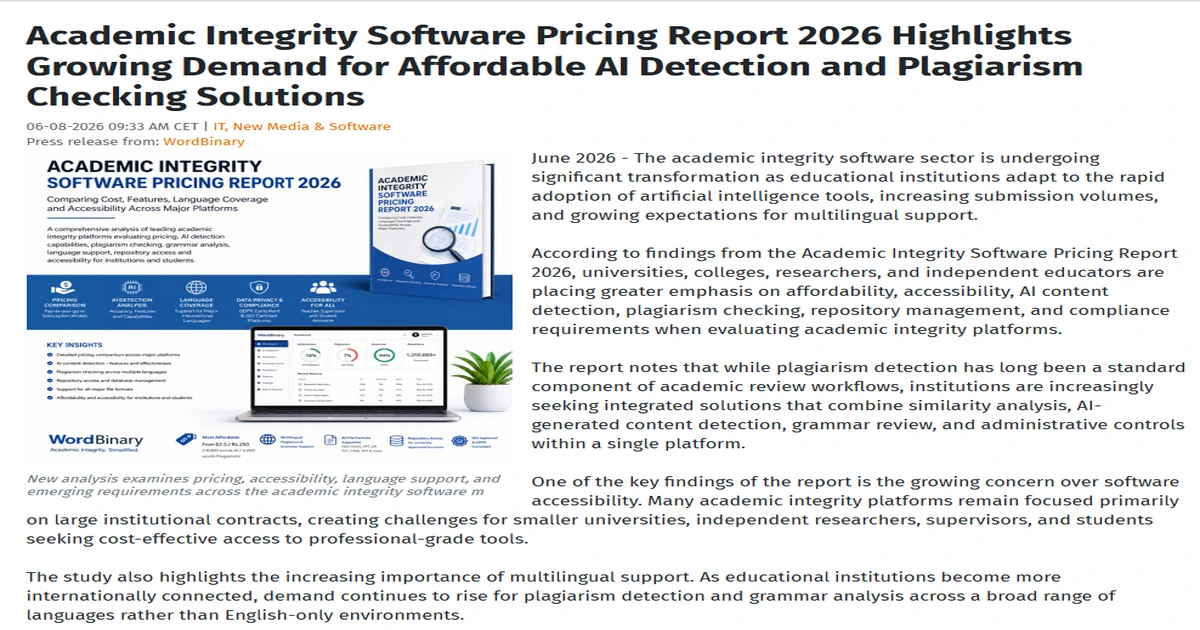
Previously, plagiarism checking was often treated as a separate process focused mainly on copied or similar text. However, academic institutions now need to review a wider range of originality and integrity concerns, including:
- AI-generated content detection;
- direct text similarity;
- paraphrased or rewritten content;
- grammar and writing quality;
- references and citation patterns;
- repository-based similarity;
- repeated submissions;
- document formatting and manipulation issues.
Because of this, educators and institutions are increasingly looking for academic integrity software that can support several checks within one workflow instead of requiring separate tools for each task.
Multilingual Support Is Becoming More Important
The report also highlights the growing importance of multilingual support. Academic institutions are now more internationally connected than ever before, and students often submit work in multiple languages.
For many users, English-only plagiarism checking is no longer sufficient. Universities, colleges, and researchers need systems that can support multilingual plagiarism analysis and grammar review across a wider range of academic and regional languages.
WordBinary supports multilingual plagiarism checking and grammar analysis, making it suitable for users who need broader language coverage in academic document review. For AI detection, WordBinary currently focuses on English-language content.
Role-Based Accounts and Repository Access
Another major trend discussed in the report is the demand for role-based academic integrity systems. Institutions often require separate access levels for teachers, supervisors, students, and administrators.
Role-based access helps institutions manage submissions, review reports, monitor document history, and control how users interact with the platform. It also supports more organised academic workflows, especially where multiple departments, teachers, or supervisors are involved.
WordBinary supports teacher, supervisor, and student account structures. Approved institutions can also use repository access, allowing them to manage internal document databases and compare submissions against institutional content where applicable.
Support for Multiple Document Formats
Academic users work with different file types, and a modern academic integrity platform must support more than basic document uploads. The OpenPR article notes growing demand for support across formats such as PDF, DOCX, PPT, PPTX, TXT, RTF, HTML, and ZIP uploads.
This is important for universities, colleges, and educators handling assignments, research papers, dissertations, presentations, reports, and bulk submissions.
WordBinary supports multiple file formats and provides downloadable reports, helping users review academic documents in a structured and accessible format.
Why This Matters for Educators and Institutions
The academic integrity software market is changing because the needs of educators are changing. Institutions need tools that are affordable, scalable, transparent, and easy to deploy.
For individual educators and supervisors, affordability and accessibility are especially important. For universities and colleges, repository control, user management, reporting, compliance, and multilingual support are becoming key selection factors.
The Academic Integrity Software Pricing Report 2026 shows that academic integrity platforms will continue to evolve as AI writing tools, multilingual education, and digital submissions become more common.
Explore WordBinary Tools
WordBinary provides an integrated academic integrity workflow for AI detection, plagiarism checking, grammar analysis, and document review.
WordBinary continues to develop affordable and accessible academic integrity solutions for educational users, researchers, institutions, supervisors, teachers, and students worldwide.