WordBinary Blog
Plagiarism Checker with Report: How to Read Similarity Results
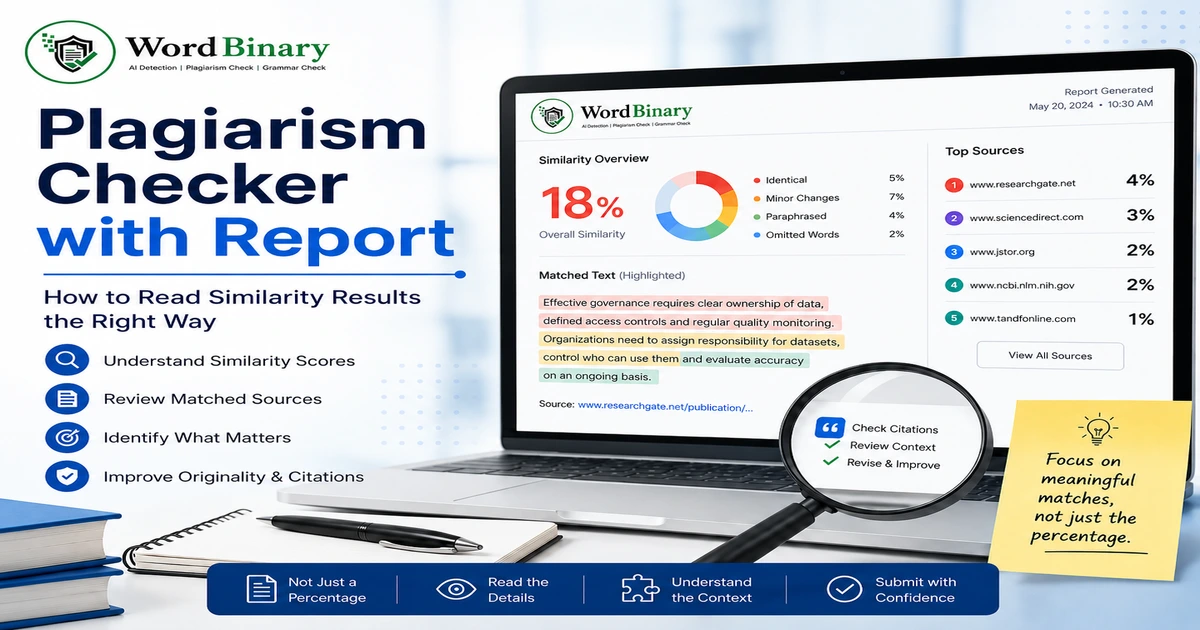
The difficult part is interpretation.
A score of 18% does not automatically mean that 18% of a document has been plagiarised. It means that the checker identified text resembling material found within the sources it searched. Some matches may come from properly quoted evidence, reference entries, technical terminology or standard wording. Others may reveal uncited copying or paraphrasing that remains too close to the original.
Major similarity-checking providers explicitly describe the similarity score as a measure of matched text rather than a finding of plagiarism. Universities also emphasise that an academic must examine the context before deciding whether misconduct has occurred. explains how to read a plagiarism report properly, which matches deserve attention and what to change before submitting academic or professional work.
Key Takeaways
- A similarity score measures detected textual overlap, not plagiarism.
- There is no universal percentage that makes every document safe or unacceptable.
- The location, length, source and purpose of each match matter more than the total score alone.
- Correctly cited quotations can still appear as similarity.
- A low score can still contain a serious uncited match.
- The aim should be responsible source use, not forcing the score towards zero.
What Does a Plagiarism Report Actually Tell You?
A plagiarism or similarity report normally answers four separate questions:
- How much of the submitted text matches other material?
- Which passages have been identified as similar?
- Which sources appear to contain comparable wording?
- How much does each source contribute to the overall result?
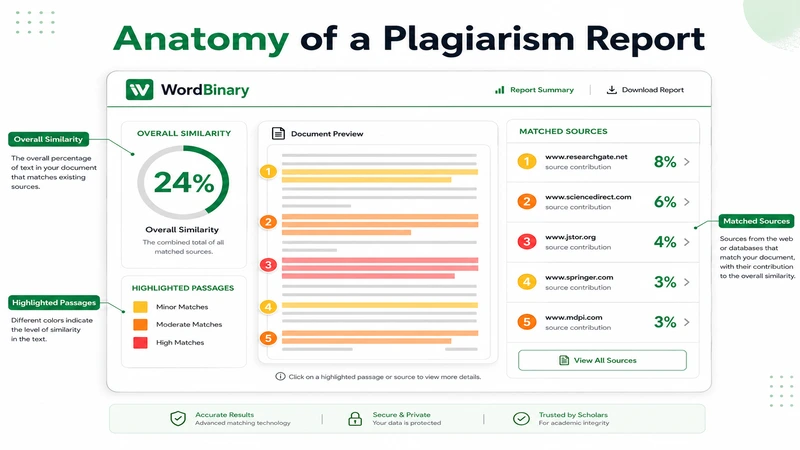
These elements should be read together.
The percentage provides a quick summary, but it removes context. A report showing 24% similarity could contain twenty minor, harmless matches. Another report showing 6% could contain one copied paragraph that is central to the argument.
A similarity checker also cannot reliably decide why a match exists. It does not know whether the writer deliberately copied a source, misunderstood paraphrasing, used a required template or correctly quoted a published definition.
This is why institutions treat the report as evidence for review rather than an automatic verdict. UCL, for example, explains that a high score requires further investigation and academic judgement rather than an immediate conclusion that plagiarism has occurred. d a Plagiarism Checker with Report Step by Step
1. Confirm What Was Checked
Before interpreting the score, verify that the correct document was uploaded and processed in full.
Check the:
- Document title
- Word count or page count
- File version
- Date of the check
- Language
- Included and excluded sections
- Search or repository settings, where shown
Students often scan an earlier draft and later assume that the report applies to the final submission. Researchers may accidentally upload a version without appendices, tables or references. A report can only describe the content that was actually analysed.
You should also check what kinds of sources the tool searches. Coverage may include public websites, publications, institutional repositories or previously submitted documents, depending on the provider and account configuration.
A document with low similarity against web sources has not necessarily been compared with every journal article, book, private database or student-paper repository in existence.
2. Read the Overall Similarity Score as a Starting Point
The overall similarity score represents the proportion of the document that the system has associated with matching material.
Do not read it as:
- The percentage of the paper that is plagiarised
- The probability that misconduct occurred
- The percentage of sources cited incorrectly
- A direct measure of writing quality
- A guaranteed pass or fail result
Correct quotations and references may still be highlighted because the wording genuinely appears elsewhere. Turnitin’s student guidance confirms that quoted and referenced text may contribute to matching results, depending on the report settings. therefore a navigation tool. It tells you how much material may need inspection, not what conclusion to reach.
3. Examine the Source Breakdown
Most useful reports show a list of matched sources and the contribution of each source.
Start with the largest source match. A single source contributing 12% deserves closer attention than twelve sources contributing 1% each.
Ask:
- Is the source genuinely connected to the highlighted text?
- Is the passage quoted?
- Is an in-text citation present?
- Does the citation point to the correct source?
- Is the wording unnecessarily close to the source?
- Does one source dominate an entire section?
- Is the match coming from a reference entry or the body of the work?
Do not assume that the first listed source is necessarily the source originally used by the writer. The same passage may appear on several websites, repositories or derivative publications. A checker may display an accessible matching page rather than the earliest or authoritative version.
Where possible, cite and review the original publication rather than a copied webpage.
4. Review the Highlighted Text in Context
Move from the source list to the highlighted passages.
Read at least the complete sentence and the sentences around it. A short highlighted phrase may look suspicious in isolation but be harmless in context. A longer passage may contain several small changes while still following the source’s wording and structure too closely.
Look for four signals:
Length: A match covering several consecutive sentences is usually more significant than a three-word phrase.
Specificity: A distinctive argument or unusual expression deserves more attention than routine terminology.
Citation: A citation acknowledges the source, but it does not automatically make copied wording acceptable.
Purpose: A quoted legal provision has a different function from an uncited paragraph in a literature review.
Highlighted text should therefore be assessed as writing, not merely as coloured sections on a page.
5. Classify Every Significant Match
A practical review becomes easier when each meaningful match is placed into one of four categories.
| Classification | Meaning | Likely action |
|---|---|---|
| Acceptable | Properly quoted, cited or unavoidable wording | Keep after checking accuracy |
| Correctable | Citation missing, incomplete or placed incorrectly | Add or correct attribution |
| Overwritten | Paraphrase follows the source too closely | Rewrite from understanding |
| Potentially serious | Extended uncited copying or reuse | Investigate and revise fully |
This approach is more useful than treating every highlighted line as equally problematic.
A 2% match containing an uncited argument may require revision. A 5% match consisting of an accurately quoted and referenced policy statement may be acceptable.
6. Check Quotations, References and Exclusions
Some reports allow users to exclude:
- Quoted material
- Bibliographies or reference lists
- Small matches
- Specific sources
- Templates or submitted material
Exclusions can make a report easier to interpret, but they should not be used simply to create a more attractive percentage.
For example, excluding the bibliography can prevent repeated article titles and publication details from inflating the result. Excluding quoted material may help reviewers focus on unattributed overlap. Official similarity-report guidance confirms that quotation, bibliography and small-match exclusions can change the percentage and produce a more focused report. usions may also hide mistakes. A passage placed inside quotation marks without a citation is not necessarily acceptable. A very short match may still be significant when it contains a distinctive claim, statistic or definition.
Always retain the original report where required and record which filters were applied.
7. Prioritise Matches by Risk, Not Colour
Similarity reports often use colours to distinguish matches or score ranges. These colours help navigation, but they do not establish severity by themselves.
Review matches in this order:
- Long passages linked to one source
- Uncited or incorrectly cited material
- Close paraphrasing
- Reused work from an earlier submission
- Quotations without page numbers where required
- References and routine phrases
- Incidental short matches
This prevents you from spending time rewriting harmless terminology while overlooking a substantial source-use problem.
What Is an Acceptable Similarity Percentage?
There is no single acceptable similarity percentage for every university, publisher, subject or assignment.
Some departments use internal percentages to trigger review, but a review threshold is not the same as a plagiarism threshold. Even where a particular percentage prompts scrutiny, an examiner still needs to inspect the actual matches.
A laboratory report may naturally contain standard method descriptions. A legal assignment may quote legislation. A literature review may contain many citations and publication titles. A reflective journal may reasonably be expected to contain less source-dependent wording.
Consider these examples:
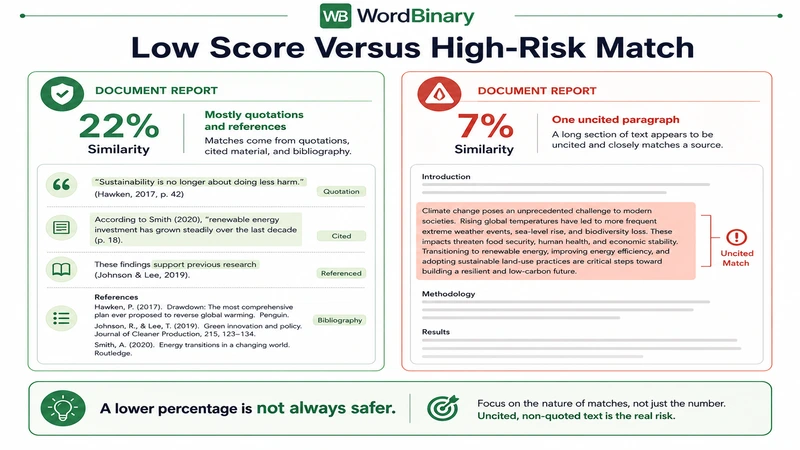
Example 1: 22% Similarity with Proper Quotations
Most matches come from quoted interview extracts, legislation and the reference list. The report may be relatively high, but the source use could still be legitimate.
Example 2: 7% Similarity with One Uncited Paragraph
The overall score appears low, but 5% comes from one source used without acknowledgement. This may be more concerning than the first example.
Example 3: 16% Similarity Spread Across Many Sources
The matches consist mainly of article titles, common academic phrases and short cited quotations. The paper may require little revision.
Example 4: 3% Similarity After Aggressive Rewriting
A low percentage does not prove that the writer developed the ideas independently. The document could still contain unattributed ideas, fabricated references or translated copying that the system did not identify.
The correct question is therefore not, “How low can I make the percentage?” It is, “Can I explain and defend every meaningful match?”
Common Types of Similarity Matches
Properly Quoted Material
A direct quotation should normally use quotation marks or block-quote formatting, an in-text citation and any locator required by the referencing style.
The report may still highlight the wording. This does not automatically make it inappropriate.
Check that the quotation:
- Is accurate
- Has not been altered misleadingly
- Uses the required citation format
- Includes a page or paragraph number where required
- Supports the surrounding analysis
Close Paraphrasing
Close paraphrasing occurs when words are changed but the source’s sentence structure, sequence and expression remain recognisable.
For example:
Source: Effective governance requires clear ownership of data, defined access controls and regular quality monitoring.
Weak paraphrase: Good governance needs clear data ownership, established access controls and frequent monitoring of quality.
The second sentence changes several words but preserves the original construction.
A stronger paraphrase would explain the idea independently:
Improved version: Organisations need to assign responsibility for datasets, control who can use them and evaluate accuracy on an ongoing basis.
The source should still be cited because the underlying idea came from another author. Oxford’s referencing guidance similarly explains that paraphrased ideas must be acknowledged and should not remain too closely derived from the source. s and Bibliographic Entries
Article titles, journal names, authors and publication details often match existing pages.
These matches usually deserve less attention when they appear inside a correctly formatted reference list. However, references should not be ignored entirely. Check for:
- Missing references
- Sources listed but never cited
- In-text citations missing from the bibliography
- Incorrect titles or authors
- References copied without consulting the source
Common or Technical Language
Some wording has few reasonable alternatives. Scientific terms, official names, statutory phrases and standard procedure descriptions may match many documents.
Do not damage accuracy by replacing necessary terminology merely to reduce similarity. Instead, determine whether the surrounding explanation is independently written and properly referenced.
Reuse of Your Own Previous Work
Text copied from an earlier assignment, report, article or proposal may appear as a match.
Writers sometimes assume that reusing their own material cannot be plagiarism. Institutional rules may nevertheless restrict undisclosed reuse, duplicate submission or recycled assessment content.
Where reuse is permitted, disclose and cite the earlier work according to the relevant policy. Where it is not permitted, develop the new submission independently.
Template and Instructional Text
Cover pages, declarations, assignment questions, ethics statements and required headings may match other submissions.
These sections may be legitimate, particularly where an institution supplied the wording. Check whether they can be excluded from analysis or identified separately without concealing substantive matches.
How to Reduce Similarity Responsibly
Reducing similarity should improve the quality and transparency of the document. It should not be a mechanical exercise in changing words.
Return to the Original Source
Read the source again and identify its actual argument. Do not rewrite only from the matched sentence because this encourages superficial synonym replacement.
Close the Source Before Drafting
After understanding the material, put the source aside and explain the idea in your own structure. Reopen it afterwards to verify accuracy and add the citation.
Quote Distinctive Wording
When the author’s exact language matters, use a direct quotation rather than disguising it as a paraphrase.
Add Missing Attribution
A well-written paraphrase still needs a citation when the idea, evidence, framework or interpretation came from a source.
Combine Sources Analytically
Instead of summarising one publication at a time, compare multiple sources around a theme. Explain where they agree, differ or leave a gap.
Remove Unnecessary Borrowed Wording
Some background material is included only because it appeared in a source. Delete sentences that do not contribute directly to the research question or business purpose.
Run a Final Review
After revising the document, use the Plagiarism checker again and compare the new report with the original. Confirm that important matches were resolved for the right reasons rather than merely shifted to different sources.
Similarity Results for Different Users
Students
Students should use a report before submission to verify quotations, references and paraphrasing. They should also consult the assignment instructions because acceptable source use varies across tasks.
Never remove valid evidence simply to lower the percentage.
Researchers
Researchers should pay close attention to literature reviews, methods sections, preprints and earlier publications. Reuse may be legitimate in some contexts, but journal and institutional disclosure requirements still apply.
A downloadable report can also help document the checks completed before manuscript submission.
Universities
Universities should avoid treating score thresholds as automatic disciplinary decisions. Reports should be reviewed alongside the assessment brief, subject conventions, citation practices, draft history and the student’s explanation.
Businesses and Professionals
Business reports may match product descriptions, legal wording, press releases or earlier proposals. The concern may involve copyright, originality, reputation or contractual requirements rather than academic misconduct alone.
Reviewers should identify whether copied wording is authorised, attributed and suitable for the intended use.
Similarity Score, Plagiarism and AI Detection Are Different
A similarity report compares text with accessible source material. An AI detector examines writing patterns that may be associated with machine-generated or AI-assisted text.
A document can therefore have:
- Low similarity and strong AI-writing signals
- High similarity and no meaningful AI concern
- Citation problems without AI use
- AI-assisted editing with properly referenced sources
- Neither similarity nor AI-related concerns
Do not interpret one score as evidence for the other.
WordBinary provides a separate AI detector for reviewing AI-related writing signals. Readers who need help interpreting that type of output can also consult the Resources section, including material on AI scores, sentence highlights, false positives and human review.
After addressing source use and AI-related concerns, the Grammar checker can be used to review clarity, punctuation and sentence flow. Grammar corrections should be completed after substantive rewriting so that polished sentences do not need to be edited repeatedly.
What to Look for in a Plagiarism Checker with Report
A reliable report should make the result understandable rather than displaying only a percentage.
Look for:
Matched Passage Highlighting
You should be able to see exactly which text contributed to the score.
Source-Level Information
The report should identify probable sources and indicate how much each source contributes.
Downloadable Documentation
A PDF or similar downloadable report is useful for record-keeping, supervisor review, client work and institutional workflows.
Meaningful Context
The report should help distinguish source overlap, quotations, references and other review signals.
Clear Limitations
A responsible provider should not claim that every match is plagiarism or that one percentage can make a final decision.
Privacy and Document Handling Information
Before uploading unpublished research, confidential documents or client material, review the provider’s privacy, storage and repository policies.
Suitable Pricing and Access
Occasional users may prefer individual checks, while universities or businesses may need structured submission allowances, account controls and report verification.
WordBinary’s plagiarism workflow is presented as a pre-submission review process with highlighted overlap, matched-source information and downloadable reports rather than an automatic misconduct judgement. ng access options can review Pricing. Those looking for direct-access similarity and academic review tools can also compare WordBinary as a Turnitin alternative, while recognising that institutional databases, integrations and policies can differ between services.
Common Mistakes When Reading a Plagiarism Report
Treating the Percentage as a Verdict
The score is an indicator of overlap. It does not establish intention, severity or misconduct.
Chasing a Zero Score
A properly researched document may legitimately contain quotations, citations and standard terminology. Turnitin notes that a genuine 0% result may be unusual in some source-based assignments. Words with Synonyms
Mechanical rewriting can create awkward sentences while preserving the original structure and idea.
Ignoring Low Scores
A small percentage can still contain one highly significant copied passage.
Deleting Citations to Reduce Matches
Removing a citation does not make borrowed material original. It makes the attribution weaker.
Applying Exclusions Without Reviewing Them
Filters can focus the report, but they can also conceal problems when used without judgement.
Assuming Every Listed Website Was Used
A matching webpage may reproduce content from another source. Trace the material back to the authoritative publication where possible.
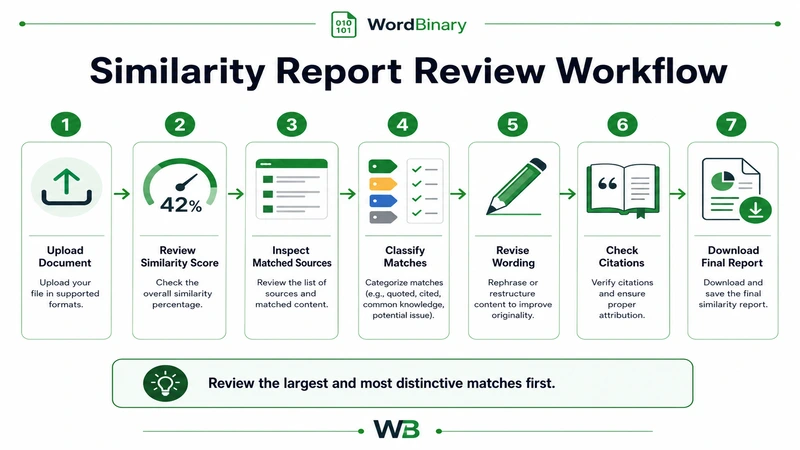
A Practical Pre-Submission Workflow
Use the following sequence:
- Complete the full draft and reference list.
- Run the similarity check.
- Review the largest source contributions.
- Inspect every long or distinctive match.
- Separate legitimate matches from correctable ones.
- Correct missing or inaccurate citations.
- Rewrite close paraphrases from genuine understanding.
- Retain exact language as properly formatted quotations where necessary.
- Recheck the revised document.
- Save the report and final file where evidence of review may be useful.
The process is complete when you can explain the source and purpose of every meaningful match, not merely when the score falls below an arbitrary number.
Conclusion
A plagiarism checker with report is most useful when it helps you understand the reasons behind similarity rather than simply presenting a percentage.
Read the overall score first, but make decisions from the highlighted passages, source contributions, citation context and institutional requirements. Correct genuine weaknesses, retain legitimate evidence and avoid rewriting accurate material merely to produce a lower number.
WordBinary can support this review through matched-source analysis and downloadable similarity reporting. The report should remain part of a wider human review process in which the writer, supervisor, editor or institution makes the final judgement.