WordBinary News
WordBinary Deployed at Dr. Rammanohar Lohia Avadh University for Academic Integrity Review
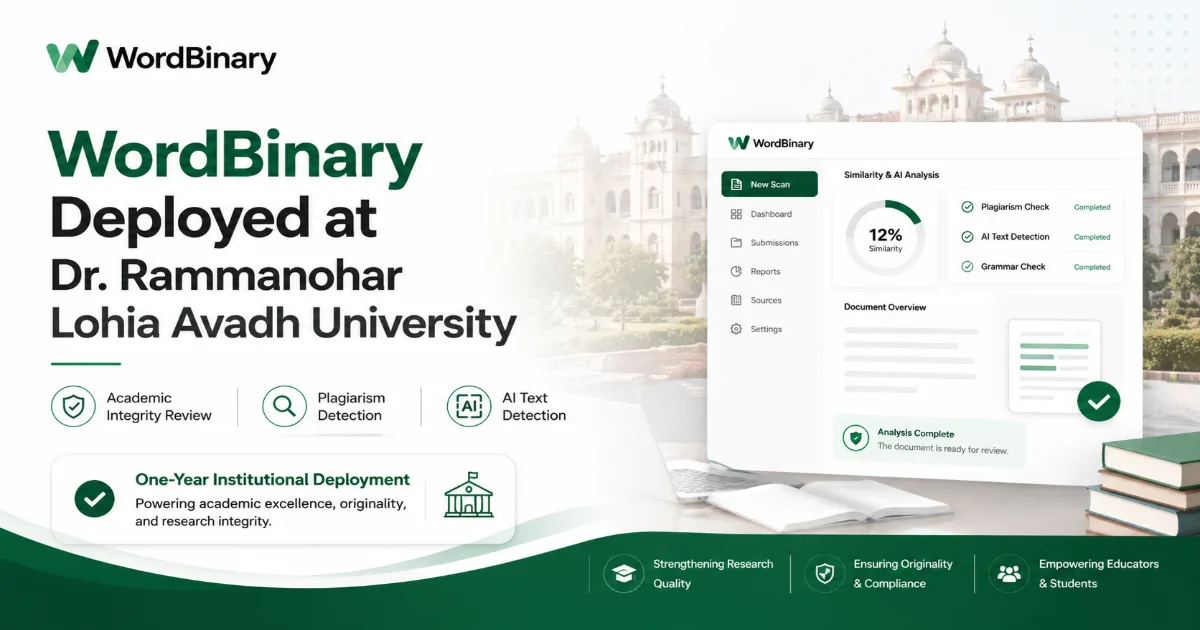
Ayodhya, Uttar Pradesh, India: WordBinary has reached an important institutional milestone. WordBinary deployed at Dr. Rammanohar Lohia Avadh University under a one-year subscription to support academic integrity review, similarity checking and plagiarism detection.
The deployment confirmation, dated 3 August 2026, was issued by the Central Library of Dr. Rammanohar Lohia Avadh University, Ayodhya. It confirms that WordBinary was supplied and is supported by Concepts and Context for institutional academic use.
Under the approved subscription, authorised users can submit documents for similarity review and receive detailed reports showing matched content and available sources. The deployment also includes AI-text detection, source-code similarity analysis and grammar checking.
This is more than the introduction of another checking tool. It represents an institutional workflow in which different forms of document evidence can be reviewed separately rather than being reduced to a single score.
Key Takeaways
- Dr. Rammanohar Lohia Avadh University has deployed WordBinary for one year.
- The approved subscription includes 50 document submissions.
- Each submission may contain up to 50,000 words.
- The deployment covers plagiarism detection, similarity checking, AI-text indicators, source-code similarity detection and grammar review.
- WordBinary provides evidence for human review rather than automatically deciding whether academic misconduct has occurred.
- Institutional features include configurable matching settings, bibliography exclusion, user dashboards, university branding and single sign-on.
WordBinary Deployed at Dr. Rammanohar Lohia Avadh University: What the Deployment Covers
The confirmed WordBinary university deployment is intended to support the university’s academic integrity, research evaluation and document-review processes.
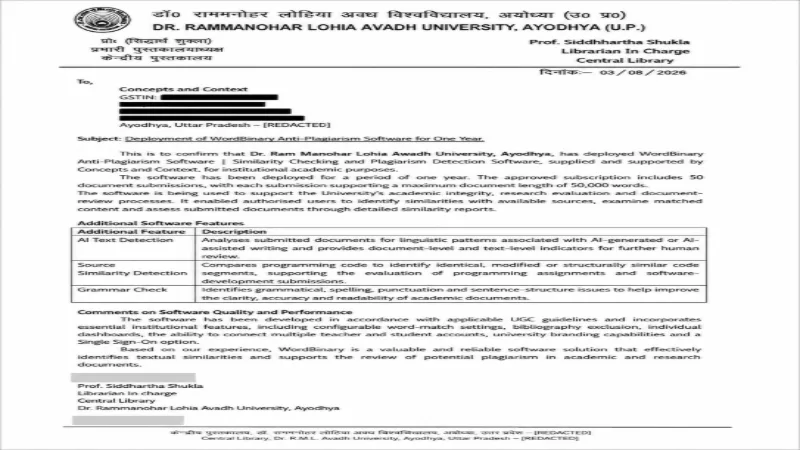
Its primary purpose is to help authorised reviewers identify textual similarities, inspect matched passages and examine the sources associated with those matches. The resulting evidence can then be considered alongside referencing practices, assignment requirements, drafts, research records and the author’s explanation.
The institutional subscription confirmed in the deployment letter includes:
| Deployment detail | Confirmed provision |
|---|---|
| Institution | Dr. Rammanohar Lohia Avadh University, Ayodhya |
| Software | WordBinary anti-plagiarism and similarity detection software |
| Subscription period | One year |
| Document allowance | 50 submissions |
| Maximum document length | 50,000 words per submission |
| Supplier and support provider | Concepts and Context |
| Additional review functions | AI-text detection, source-code similarity and grammar checking |
| Confirmation date | 3 August 2026 |
These figures describe the approved subscription recorded in the confirmation letter. They should not be interpreted as general limits applying to every WordBinary institutional plan.
A Combined Academic Document Review Workflow
Academic review becomes more useful when different questions are handled by different analytical functions. Similarity, AI-writing indicators, source-code overlap and language quality are related to document assessment, but they do not measure the same thing.
WordBinary keeps these areas distinct.
Similarity checking and plagiarism review
The plagiarism checker compares submitted writing with available sources and identifies matching or closely corresponding material. Reviewers can then examine where the similarity occurs and whether the passage has been quoted, cited, paraphrased or left unattributed.
A similarity percentage alone does not establish plagiarism. A correctly quoted passage, a bibliography entry and an improperly copied paragraph may all contribute to similarity, but they require very different interpretations.
That distinction is particularly important in dissertations, research articles and literature reviews, where references and necessary technical expressions may create legitimate matches.
WordBinary’s role as a university similarity checking software platform is therefore to organise evidence for review, not to replace the reviewer.
AI-text indicators for further assessment
The institutional deployment also includes AI-text analysis. The WordBinary AI detector examines linguistic patterns associated with AI-generated or AI-assisted writing and provides document-level and text-level indicators.
These indicators can help reviewers identify passages that may require closer attention. They should not, however, be interpreted as direct proof that a student used an AI system improperly.
Human writing can sometimes display patterns associated with machine-generated text. AI-assisted passages may also be heavily revised. Results may change depending on the length, language, genre and structure of the submitted document.
For this reason, responsible use of AI detection software for universities should include:
- reviewing highlighted passages in context;
- checking drafts, notes and version history where available;
- considering the author’s language background;
- examining whether AI use was permitted or declared;
- applying the institution’s current policy;
- allowing the student or researcher to explain their writing process.
WordBinary’s Resources section provides further guidance through topics such as AI Detection False Positives, What Does AI Score Mean?, Sentence Highlights Explained, Limitations of AI Detectors and How to Review AI Reports.
Source-code similarity detection
Programming assignments require a different form of review from essays and dissertations. Two code submissions may perform the same task without being improperly copied, while another pair may use renamed variables and rearranged functions to conceal substantial overlap.
The source-code similarity function compares programming code for identical, modified or structurally similar segments. This can support the examination of software-development work, coding exercises and programming assignments.
A practical review may involve considering:
- whether the assignment required all students to follow the same template;
- how much original code each student was expected to write;
- whether common libraries or instructor-provided functions were used;
- whether similar mistakes appear in the same sequence;
- whether the students can explain the logic of their submissions.
A source code similarity detection software result is most useful when combined with the assignment brief and an informed review of the code.
Grammar and writing-quality review
The deployment also includes grammar checking for grammatical, spelling, punctuation and sentence-structure issues.
The WordBinary grammar checker can help users identify possible language problems before a document is finalised. This function is separate from plagiarism and AI detection. A grammatically polished paper is not necessarily original, just as a paper containing language errors is not necessarily academically weak or dishonest.
Maintaining these separate outputs helps prevent users from confusing writing quality with authorship or originality.
Why an Integrated Review Model Matters
Universities increasingly review documents that contain several kinds of evidence at once.
Consider a postgraduate dissertation containing:
- correctly quoted material;
- weakly paraphrased source text;
- standard methodological terminology;
- passages edited with an AI assistant;
- a long reference list;
- grammar and punctuation errors.
A single combined percentage would not explain those issues clearly. The reviewer needs to know which passages match external sources, which sections display AI-associated patterns and which sentences simply need language correction.
An institutional plagiarism checker is therefore more useful when its outputs can be separated and interpreted independently.
The same principle applies to programming submissions. Text similarity may reveal overlap in explanatory comments, while code analysis may identify structural correspondence within the program itself. Each finding needs its own evidential context.
Institutional Features Supporting University Use
According to the deployment confirmation, WordBinary includes institutional capabilities intended to support controlled use across university accounts. These include:
- configurable word-match settings;
- bibliography exclusion;
- individual user dashboards;
- connectivity between multiple teacher and student accounts;
- university branding options;
- single sign-on functionality.
These features matter because an academic integrity platform in India may need to serve different user groups without treating every user as an independent consumer account.
A research supervisor may need to review a dissertation. A faculty member may need to examine student assignments. A library administrator may require oversight of account access and document allowances. Students may need clearly defined submission permissions.
A multi-user plagiarism checking platform should therefore support both document analysis and account administration.
About Dr. Rammanohar Lohia Avadh University
Dr. Rammanohar Lohia Avadh University is based in Ayodhya, Uttar Pradesh. The Government of Uttar Pradesh established the institution as Avadh University in 1975. It was renamed Dr. Rammanohar Lohia Avadh University in 1993–94.
The university’s Central Library was established in 1985 and moved into its own building in 2001. The university states that the library holds approximately 179,798 books and provides facilities including Wi-Fi, electronic journals and a computer laboratory. It also describes the library as undergoing continued digitalisation.
Its published library services include reference support, online thesis searching through Shodhganga, journal and database access, DELNET services and online union-catalogue searching.
The WordBinary RMLAU deployment fits within this broader environment of library-supported research, digital resources and academic document review.
What the Deployment Means for Different Users
For students
Students may use similarity and language reports to identify referencing, paraphrasing or writing issues before final academic decisions are made, subject to the university’s access arrangements.
Students should not attempt to reduce a percentage mechanically by replacing words or using automated rewriting tools. The better approach is to examine each match, return to the original source and decide whether the passage requires quotation, citation, genuine paraphrasing or removal.
The article How to Use ChatGPT Ethically, available through the WordBinary resource library, can also help students distinguish permitted assistance from undeclared or inappropriate use.
For faculty members and reviewers
Faculty members can use document-level results to locate passages requiring investigation. The report should be treated as the beginning of the review, not its conclusion.
A high similarity score may be influenced by quoted material or references. A low score may still contain one serious unattributed passage. Likewise, an AI indicator should be considered alongside process evidence and the relevant university policy.
For researchers
Research documents often contain technical language, source quotations, prior publications and extensive reference lists. Bibliography exclusion and configurable matching settings can help reviewers focus on the portions of a document that require substantive examination.
A research plagiarism detection software workflow should also consider legitimate text reuse, properly disclosed prior publication and discipline-specific conventions.
For institutional decision-makers
University administrators and procurement teams should evaluate more than the headline accuracy claim of any software. Relevant questions include:
- What sources can the platform search?
- How are reports presented?
- Can matched passages be inspected individually?
- Are references and bibliographies handled appropriately?
- How are AI indicators explained?
- Can user roles and submission allowances be controlled?
- What support is available during deployment?
- How are uploaded documents stored and retained?
- Can the institution configure the workflow around its own policy?
Institutions comparing WordBinary with other systems can review its position as a Turnitin alternative while assessing whether the workflow meets their specific academic and administrative requirements.
What This Announcement Does and Does Not Establish
The deployment confirmation establishes that WordBinary has been supplied for a one-year institutional subscription at Dr. Rammanohar Lohia Avadh University and identifies the included functions and subscription allowance.
It does not, by itself, establish:
- that every department or affiliated college is using the software;
- that every student has direct access;
- that the university has endorsed every marketing statement made by WordBinary;
- that software results automatically determine academic misconduct;
- that the deployment constitutes independent validation of detection accuracy;
- that WordBinary is approved or certified by the UGC.
These distinctions should remain clear in any republication of the announcement.
Similarity and AI-detection tools provide indicators. Whether a particular case involves plagiarism, undeclared AI use, collusion or another academic integrity concern must be determined through the applicable institutional process.
A Step Forward for WordBinary Institutional Software
The confirmation that WordBinary deployed at Dr. Rammanohar Lohia Avadh University marks an important development in WordBinary’s institutional work.
The deployment brings plagiarism and similarity review, AI-text indicators, source-code comparison and grammar analysis into one structured environment. More importantly, it supports a review model in which evidence can be examined by authorised users rather than converted automatically into a disciplinary conclusion.
Universities, colleges, research organisations and educational service providers assessing similar requirements can explore WordBinary’s available pricing, review its specialist tools and contact the WordBinary team to discuss an appropriate institutional configuration.