WordBinary News
WordBinary Launches Multilingual AI Detection in 27 Languages
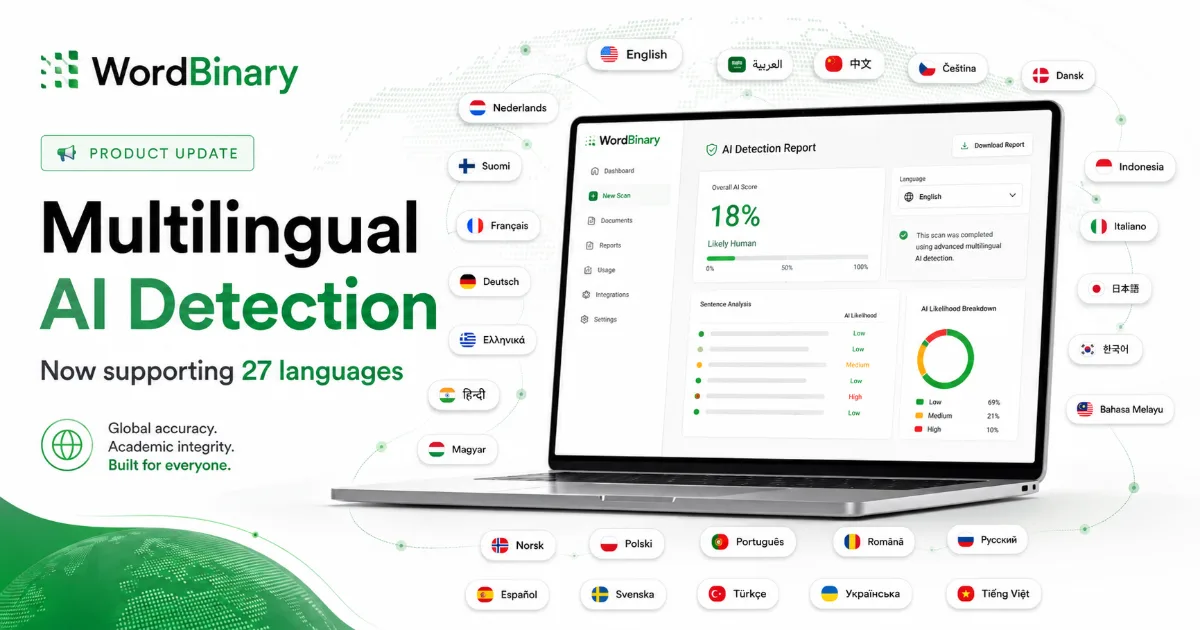
AYODHYA, INDIA, 27 July 2026: WordBinary has expanded its AI detection capabilities with the launch of multilingual AI detection across 27 languages. The new functionality enables students, universities, researchers, business owners, beginners and professionals to review content in its original language without translating it into English before conducting an AI writing assessment.
The expansion addresses a practical problem for people working with multilingual documents. Translating an essay, research paper, report or article before checking it can change sentence structure, vocabulary, phrasing and tone. The translated version is no longer identical to the text that the writer originally produced.
WordBinary’s multilingual capability allows users to examine original-language content for patterns that may be associated with AI-generated writing. The result is designed to support closer review rather than make an automatic judgement about how a document was created.
Users can access the WordBinary AI detector and submit content written in any of the currently supported languages.
Key Takeaways
- WordBinary now offers multilingual AI detection across 27 languages.
- Users can analyse original-language content without translating it into English first.
- The feature supports academic, research, publishing, business and professional workflows.
- AI detection results should be treated as indicators, not conclusive proof of AI use.
- WordBinary also provides plagiarism checking, grammar review, source-code similarity detection and self-plagiarism analysis.
Which Languages Does WordBinary Support?
WordBinary currently supports AI text detection in the following languages:
English, Arabic, Chinese, Czech, Danish, Dutch, Finnish, French, German, Greek, Hindi, Hungarian, Indonesian, Italian, Japanese, Korean, Malay, Norwegian, Polish, Portuguese, Romanian, Russian, Spanish, Swedish, Turkish, Ukrainian and Vietnamese.
This coverage enables users to review many common forms of written material, including:
- Academic essays and assignments
- Research papers and dissertations
- Journal manuscripts and abstracts
- Business reports and proposals
- Educational resources
- Website and marketing content
- Professional correspondence
- Multilingual publications
- Translated and locally produced content
Language support does not mean that every document will produce the same type of result. Writing conventions, sentence structures, vocabulary and document formats vary across languages. Results should therefore be interpreted within the context of the language, document type and writing process.
Why Multilingual AI Detection Matters
Generative AI can assist with brainstorming, drafting, rewriting, translation, summarisation and language correction. A document may contain entirely human writing, fully generated text, lightly edited AI output or a mixture of human and AI-assisted sections.
This makes authorship assessment more complex than assigning a single label to an entire document.
For example, a researcher may write a paper independently but use an AI tool to improve the wording of an abstract. A student may use AI to create an outline but write the final assignment without generated text. A business owner may ask a writer to revise AI-generated product descriptions. A professional may translate a report and then edit it manually.
A multilingual AI detector can help identify sections that may require closer attention, but it cannot independently reconstruct every step of the writing process.
Why Translating Before Checking Can Be Misleading
Suppose a university receives an assignment written in Hindi. Translating it into English before conducting an AI check could alter the sentence order, vocabulary and level of formality.
Similarly, an Arabic essay, Chinese report or Spanish research summary may contain language-specific patterns that do not survive translation. Even a good translation produces a new linguistic version of the document.
Direct multilingual analysis reduces this additional layer of alteration. It allows the submitted text to be reviewed closer to its original form.
How WordBinary’s Multilingual AI Detection Works
WordBinary analyses the submitted writing and provides probability-based indicators for patterns that may be associated with AI-generated text. The report is intended to help the user decide which parts of a document deserve further examination.
Users should consider both the document-level assessment and any sentence-level indicators presented in the report. A single percentage should not be interpreted without examining the underlying text.
For readers who need help understanding their results, the WordBinary Resources section includes guidance on topics such as:
- Understanding WordBinary AI Detection
- What Does AI Score Mean?
- Strong AI vs Moderate AI
- Why AI Scores Change
- How AI Detection Tools Work
- AI Detection False Positives
- How Human Writing Gets Flagged
- Sentence Highlights Explained
- Document-Level vs Sentence-Level Analysis
- How to Review AI Reports
These resources are designed to help users move beyond the headline score and examine what the report actually indicates.
A Practical Academic Scenario
Consider an assignment written in Spanish. The overall result shows moderate AI indicators, but the sentence-level review identifies only two paragraphs with stronger patterns.
The responsible response is not to assume that the entire assignment was generated by AI. A university reviewer could examine the student’s drafts, compare the highlighted paragraphs with previous writing, review the references and ask the student to explain the relevant arguments.
The reviewer should also consider whether the university permitted limited AI assistance for outlining, language correction or idea development.
The detection report helps focus the investigation. It does not replace the investigation.
A Practical Business Scenario
A business owner commissions a French-language article from an external writer. The report identifies stronger AI indicators in the introduction but fewer indicators in the main analysis.
The business owner could ask the writer about the production process, request source notes and review whether the content meets the agreed originality requirements. This approach is more useful than rejecting the article solely because of one score.
AI Detection Is Not the Same as Plagiarism Detection
AI detection and plagiarism checking answer different questions.
AI detection examines linguistic patterns that may be associated with generated writing. A Plagiarism checker compares submitted content with available sources and identifies matching or closely similar text.
A document can produce a high AI probability while containing little or no source overlap. It can also be entirely human-written while containing copied passages or poorly attributed material.
Similarity does not automatically prove plagiarism either. Quotations, reference entries, commonly used phrases and correctly attributed material may produce matches. The report must be interpreted in context.
Using a plagiarism checker with report-level source information can help users distinguish between acceptable matching text and material that may require citation, quotation or rewriting.
Grammar Review Serves a Different Purpose
Grammar quality should also be assessed separately from AI probability.
A grammatically correct document is not necessarily AI-generated. Human writers can produce polished content, while AI-generated writing can contain factual, stylistic or grammatical problems.
The WordBinary Grammar checker helps users identify language issues that may affect correctness, clarity and readability. It should not be used as evidence of authorship.
Separating AI indicators, similarity results and grammar findings prevents users from combining unrelated signals into one unsupported conclusion.
Who Can Use Multilingual AI Detection?
Students and Beginners
Students can review drafts before submission and examine sections that appear unusually formulaic, repetitive or inconsistent with the rest of the document.
They should also check their institution’s AI policy before using generative tools. WordBinary’s resource library covers topics such as Fair Use of Generative AI, How to Use ChatGPT Ethically, AI-Assisted Writing Guidelines, Undeclared AI Use Risks and AI Risk Before Submission.
The purpose of a pre-submission check should be to understand the document and maintain transparency, not to manipulate text merely to evade detection.
Universities and Educators
Universities can use multilingual AI detection as one component of an academic integrity process. The result may help identify sections for discussion, but disciplinary decisions should consider institutional rules, supporting evidence and procedural fairness.
Relevant evidence may include:
- Earlier drafts and version history
- Research notes and outlines
- Referenced sources
- Previous examples of the student’s writing
- The student’s explanation of the work
- Declared use of AI or editing tools
- Assignment-specific instructions
Users comparing different academic integrity platforms can also review WordBinary as a Turnitin alternative. Any comparison should consider language support, available reports, workflow requirements, document limits and the type of analysis required.
Researchers and Publishers
Researchers may use the tool to review abstracts, manuscripts, literature summaries and multilingual submissions. Publishers can examine commissioned articles and translated material before publication.
An AI score should not replace editorial review. Source accuracy, attribution, originality, methodology and factual reliability remain separate concerns.
Business Owners and Professionals
Business users can review reports, website copy, proposals, outsourced articles and multilingual marketing material. The report can support quality-control discussions with writers, agencies and contractors.
Professionals should establish clear expectations about permitted AI assistance before commissioning work. A transparent content policy is more effective than trying to determine authorship only after the document has been delivered.
How to Review an AI Detection Report Responsibly
Use a Meaningful Text Sample
A very short extract provides fewer patterns to assess. Where possible, review a complete section or document rather than one isolated sentence.
Submit the Original-Language Version
Use the original text whenever it is available. Avoid translating the content solely for the purpose of obtaining a detection result.
Examine the Highlighted Content
Review the specific sentences or paragraphs associated with stronger indicators. Consider whether they differ significantly from the rest of the document.
Compare Other Evidence
Academic reviewers should examine drafts, notes and writing history. Businesses may review briefs, source files, revision records and communication with the writer.
Avoid Automatic Penalties or Rejection
An AI score alone should not determine whether a student is penalised, a paper is rejected or a writer is accused of misconduct. The result should prompt a proportionate review.
Understanding the Limitations
AI detection is a probability-based form of analysis. It cannot directly observe whether a writer opened an AI tool, generated a paragraph, worked with an editor or revised a document over several weeks.
Formal academic writing may naturally contain structured sentences and repeated terminology. Non-native writers may use consistent patterns. Translation, paraphrasing and extensive editing can also influence how a document is assessed.
Different sections of the same document may therefore produce different indicators.
The most useful question is not simply, “What is the score?” A better set of questions is:
- Which sections produced stronger indicators?
- Does the writing differ from earlier drafts?
- Is there supporting evidence about the writing process?
- Was AI assistance permitted or declared?
- Does the result justify further review?
This approach supports better academic, editorial and professional decisions.
WordBinary’s Wider Document Review Workflow
Multilingual AI detection forms part of WordBinary’s broader document analysis platform. Depending on the task, users can combine AI pattern analysis with plagiarism checking, grammar review, source-code similarity detection and self-plagiarism comparison.
Each check addresses a different part of document quality and originality. Keeping the results separate helps users understand what the evidence does and does not show.
Individuals and organisations evaluating access options can visit Pricing to review the available plans and identify an option suited to their document volume and intended workflow.
Conclusion
WordBinary’s multilingual AI detection capability gives users a direct way to review original-language content across 27 languages. It is designed for students, universities, researchers, business owners, beginners and professionals who need clearer insight into possible AI-generated writing patterns.
The expansion reduces the need to translate documents before analysis and supports a more relevant review of multilingual content. However, the result should remain one part of a wider assessment. Context, writing history, institutional policy and human judgement are still essential.
To review content in one of the supported languages, visit the WordBinary AI detector and examine the report alongside the wider document evidence.
Questions
Related Pages
- WordBinary News: Academic Integrity Software Pricing Report 2026 Highlights Demand for Affordable AI Detection and Plagiarism Checking
- AI Detection Model Accuracy: WordBinary’s Latest Model Tested on 9,000 AI Texts and 2,000 Human Papers
- AI Detection Confidence Benchmark 2026: WordBinary, Turnitin and GPTZero in a Zenodo Study