WordBinary Blog
What Does a 70% AI Score Mean? AI Detection Model Accuracy Explained
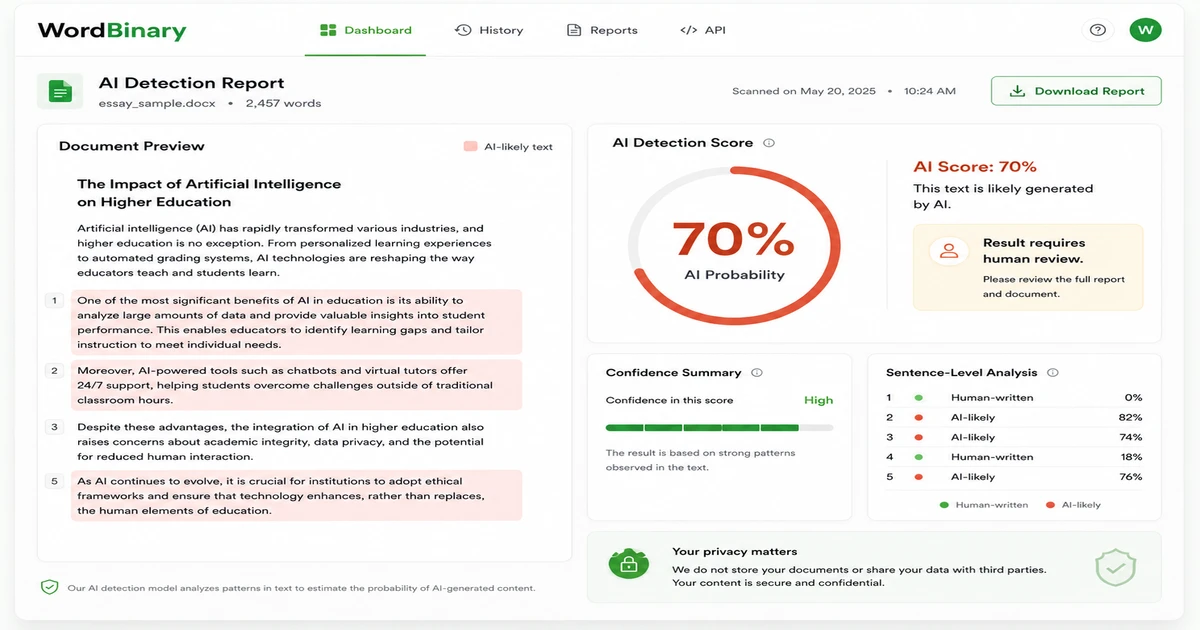
A 70% AI score can look decisive, but understanding AI detection model accuracy is essential before interpreting the result. Depending on the tool, the percentage may represent the proportion of qualifying text flagged as AI-generated, a probability estimate, or a combined document-level score. It does not automatically mean that 70% of the document was written by AI or that the writer has a 70% chance of misconduct.
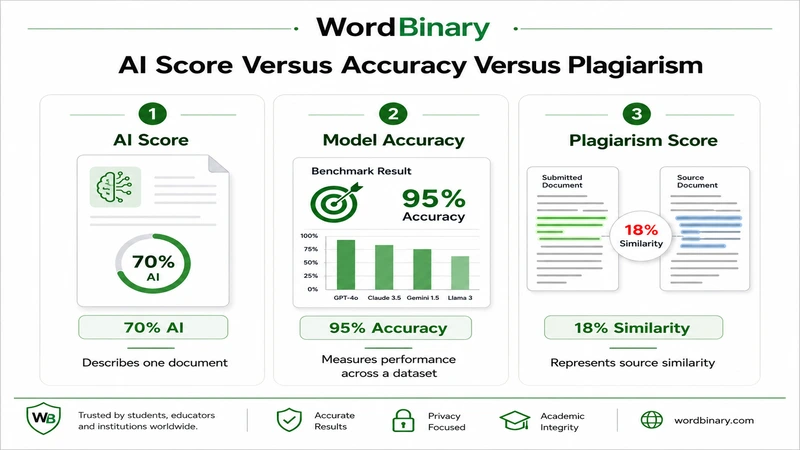
In most cases, a 70% result means that the detector found substantial patterns associated with AI-generated writing. It does not automatically mean that 70% of the document was copied from ChatGPT, that the writer has a 70% chance of being guilty, or that the detector itself is 70% accurate. The exact AI detection score meaning depends on how the platform calculates and labels its output.
AI detection model accuracy and an individual score are not the same thing. A score describes one document; accuracy describes performance across many known human and AI samples. Responsible interpretation requires the score definition, highlighted passages, writing context and the detector’s limits.
Key Takeaways
- A 70% AI score is a strong review signal, not proof of AI use or misconduct.
- Some tools report the share of eligible text flagged; others report a probability, confidence value or combined document score.
- The score is separate from plagiarism or similarity.
- Sentence-level evidence, drafts, version history and the writer’s explanation matter more than the headline number alone.
- AI detection model accuracy should be judged through false-positive rates, false-negative rates, calibration and performance on relevant writing types.
What Does a 70% AI Score Mean?
The safest plain-English interpretation is:
The detector found strong AI-like signals across a substantial part of the text or assigned the document a relatively high AI probability, according to that tool’s own scoring method.
The wording “according to that tool” is essential. There is no universal scoring standard used by every AI detector.
It may mean 70% of qualifying text was flagged
Some platforms calculate the percentage from the portion of a document they consider suitable for analysis. This may include normal prose paragraphs while excluding tables, bullet points, references, code, poetry or very short fragments.
For example, imagine a 2,000-word report containing 1,600 words of qualifying prose. If a tool uses a text-coverage score and reports 70%, the result could mean that AI-like patterns were identified across roughly 70% of those 1,600 eligible words or sentences. That is approximately 1,120 words of coverage, although actual systems may calculate at sentence or segment level rather than counting individual words.
Turnitin’s current guidance, for example, defines its percentage as the amount of qualifying text that its model identifies as likely AI-generated or AI-generated and subsequently modified with an AI paraphrasing tool. It also states that this AI percentage is independent of the similarity score. an a 70% probability or confidence value
Another detector may use an AI probability score. In that system, 70% could mean that the model assigns the document, paragraph or sentence a 0.70 probability of belonging to the AI-generated class.
That still does not translate into “there is a 70% chance the student cheated”. A classifier probability depends on the model, training data, threshold and calibration. A poorly calibrated model can be confident and still be wrong on unfamiliar writing.
It may be an aggregate score
Some systems combine sentence predictions into a document-level result. They may average probabilities, weight longer passages more heavily, count sentences above a threshold, or combine several linguistic signals.
This means two tools can analyse the same document, both display “70%”, and still be reporting different things. Before comparing tools, read the score definition rather than assuming the numbers are interchangeable.
A 70% AI Score Is Not the Same as AI Detection Model Accuracy
This is the most common interpretation error.
A document score answers: What did this model conclude about this text?
AI detection model accuracy answers: How often does this model classify known human and AI texts correctly across a defined evaluation set?
A detector could report a 70% AI score while having very high, moderate or poor overall accuracy. You cannot infer one from the other.
Useful accuracy measures include:
False-positive rate: How often human-written work is incorrectly labelled as AI-generated.
False-negative rate: How often AI-generated text is incorrectly labelled as human.
Precision: Of all documents flagged as AI, how many were actually AI-generated in the test set.
Recall: Of all genuinely AI-generated documents, how many the detector found.
Calibration: Whether a score such as 70% is correct about seven times out of ten among comparable cases.
Domain performance: Whether the model remains reliable on dissertations, school essays, business reports, scientific papers, legal writing and multilingual English.
These measures can move in different directions. A sensitive model may catch more AI text but flag more human writing. A strict model may reduce false accusations but miss edited AI output. One advertised accuracy percentage means little unless the benchmark, sample composition, threshold and error rates are disclosed.
OpenAI’s discontinued text classifier is a useful historical warning. OpenAI withdrew it in July 2023 because of its low accuracy and had already cautioned that it should not be used as a primary decision-making tool. Its published limitations included problems with short text, non-English content, predictable writing and edited AI output. Score Could Look Like in Practice
The same result can arise from very different writing processes. The report needs to be read alongside the document.
Scenario 1: Mostly unedited AI-generated prose
A user asks a chatbot to write a 1,500-word essay, adds a title and submits the output with little revision. The text may contain consistent rhythm, predictable transitions, repeated paragraph structures and limited personal reasoning.
A 70% score would be plausible here. The key evidence would not be the number alone, but whether long connected passages are highlighted and whether the writer can explain the argument, sources and drafting choices.
Scenario 2: A human-written but highly formulaic report
A student follows a rigid template: topic sentence, definition, example, mini-conclusion, repeated in every paragraph. The vocabulary is controlled, the tone is impersonal and the sentence lengths barely vary.
Those features can resemble machine-generated prose even when the work is genuinely human. Research has found that some detectors can disadvantage non-native English writers, partly because predictable language patterns may be treated as AI-like. A widely cited 2023 study reported frequent misclassification of non-native English writing across seven detectors, showing why a high score should be investigated rather than treated as conclusive evidence. 3: AI-assisted planning followed by genuine human writing
A professional uses AI to brainstorm headings, then writes the article independently from interviews, notes and subject knowledge. Some sections may retain generic structural patterns, while others contain original examples and domain-specific judgement.
A detector may produce a mixed result. Acceptability depends on the relevant policy. The better question is: what role did AI play, was it permitted, and was disclosure required?
Scenario 4: Human writing heavily processed by tools
Grammar correction, translation, rewriting and style tools can make prose more uniform. That does not prove AI authorship, but it can change the signals a detector sees.
Writers should not distort work to “beat” a detector. Retain drafts, revise meaningfully, add evidence and ensure the final text reflects your own reasoning. WordBinary’s resource on Why AI Scores Change explains why even modest textual changes can alter a result.
Scenario 5: A mixed document
A dissertation might contain original analysis, standard methodology language, quoted definitions, a literature review, tables, references and a small AI-assisted section. A single document-level score can hide this variation.
This is where sentence-level highlights become valuable. A 70% headline score deserves attention, but reviewers should ask whether the marked text is concentrated in one section or spread across the entire submission. The distinction between document-level and sentence-level analysis can materially change the interpretation.
How Students and Writers Should Respond to a 70% AI Score
First, do not panic and do not start replacing words randomly. Mechanical rewriting can damage clarity without addressing the underlying issue.
Open the full report and identify the highlighted passages. Look for patterns:
- Are complete sections marked or only isolated sentences?
- Are definitions, standard academic phrases or references being flagged?
- Does the report react strongly to an introduction but not to the analysis?
- Does the highlighted language genuinely reflect your normal writing?
- Did you use a chatbot, paraphraser, translator or rewriting tool at any stage?
Compare the result with evidence of authorship: outlines, notes, saved drafts, tracked changes, document history, source annotations and earlier writing. These show a process the score cannot reconstruct.
Check the relevant AI policy. Universities differ on whether AI may be used for brainstorming, language assistance, coding, translation, editing or drafting. A permitted use can still require disclosure. WordBinary’s Resources include guidance on fair use, university policy, undeclared AI use and ethical use of ChatGPT.
Then revise for substance, not concealment. Add your own reasoning, connect claims to sources, remove unsupported generalisations, explain why evidence matters and make the argument specific to the task. Use a grammar checker after the intellectual revision, not as a substitute for it.
Finally, rerun the document only when the revision is meaningful. Repeatedly changing words until a score drops can turn the exercise into detector optimisation rather than better writing.
How Universities, Researchers and Employers Should Review a 70% Result
A high AI score should initiate a review process, not complete one.
Turnitin’s own guidance says its model may misidentify human, AI-generated and AI-paraphrased text, and that the result should not be the sole basis for adverse action. It recommends human judgement and consideration of institutional policy. can combine several forms of evidence:
- Read the highlighted text. Determine whether the patterns are coherent, repeated and substantial.
- Compare known writing. Look for abrupt changes in vocabulary, sentence control, citation practice or subject knowledge.
- Review the writing process. Draft history, notes and source records can clarify authorship.
- Ask content-based questions. A short discussion about the argument, method and evidence is often more informative than debating a percentage.
- Apply the stated policy. Distinguish prohibited generation from permitted assistance and declared use.
- Consider language and accessibility. Formulaic or carefully simplified English should not be treated as misconduct by default.
- Record the reasoning. Any decision should explain how the report was interpreted and what corroborating evidence was considered.
Before institutional adoption, test the detector on local material. Universities should evaluate relevant academic English, publishers should test manuscripts, and companies should use their own report types. General benchmarks may not transfer to every domain.
Is 70% AI the Same as 70% Plagiarism?
No. AI detection and plagiarism detection answer different questions.
An AI detector estimates whether linguistic patterns resemble machine-generated writing. A plagiarism checker compares text with sources or repositories to identify matching or similar material.
A document can have:
- a high AI score and low similarity because newly generated text may not match published sources;
- a low AI score and high similarity because a human copied existing material;
- high results on both if generated text includes reused source language;
- low results on both if the work is original and human-written.
Treating these scores as interchangeable leads to poor decisions. They should be reviewed as separate evidence streams.
Why Can a 70% Score Change on Another Tool or Recheck?
AI detectors use different models, datasets, thresholds, supported languages and definitions of eligible text. Formatting may also affect what is analysed.
A score may change when:
- sentences are added, deleted or reordered;
- quotations, references or tables are handled differently;
- grammar or paraphrasing tools alter predictability;
- the detector model is updated;
- a different platform aggregates sentence scores differently;
- the document is too short or contains limited qualifying prose.
Research evaluating detectors across unfamiliar domains and models has shown that performance can deteriorate outside controlled test conditions and after relatively modest text transformations. That is another reason to avoid treating cross-platform scores as directly comparable. ge AI Detection Model Accuracy Before Choosing a Tool
When comparing services, do not ask which detector gives the toughest score. Ask which provides a transparent, reviewable and suitably validated result for your use case.
Assess these points:
1. What does the percentage mean?
The provider should explain whether it represents flagged text coverage, document probability, sentence aggregation or another measure.
2. Is evidence shown?
A useful report should identify the passages that influenced the score. A bare percentage is difficult to audit and easy to misuse.
3. How are false positives handled?
Look for published limitations, cautious thresholds and instructions against using the score as sole evidence.
4. Is testing relevant to your documents?
Performance on long English essays does not automatically establish performance on abstracts, code, legal documents, bullet-heavy reports or multilingual writing.
5. Are results consistent enough to review?
No model will be perfectly stable, but unexplained large changes after minor formatting edits should raise questions.
6. Can the result be documented?
Downloadable reports, sentence highlights and clear score explanations are useful when a result needs to be reviewed by a student, supervisor, editor, client or compliance team.
7. Does the service fit the wider workflow?
Many users need AI review alongside similarity and language checking. WordBinary combines an AI detector, plagiarism checking and grammar review, with report-based interpretation rather than relying only on a headline percentage. Users comparing access models can review Pricing, while those assessing alternatives for individual or institutional use can examine the Turnitin alternative page.
How WordBinary Helps You Interpret a 70% AI Score
WordBinary presents AI detection as decision support. Its reports combine document-level AI probability with sentence-level patterns, allowing readers to inspect stronger signals rather than relying on the headline result alone. ult, the practical workflow is:
- Review the overall score.
- Examine the highlighted passages.
- Separate strong, sustained signals from isolated formulaic sentences.
- Consider the writer’s process, permitted AI use and supporting drafts.
- Check plagiarism and grammar separately.
- Make a contextual judgement rather than treating 70% as an automatic verdict.
The detailed resource on What Does AI Score Mean? and the guide to reviewing AI reports provide further support for interpreting results responsibly.
Conclusion
A 70% AI score usually indicates substantial AI-like writing signals, but its precise meaning depends on the detector. It may represent flagged text coverage, an AI probability score or an aggregate of sentence-level predictions.
It does not establish authorship, intent or misconduct by itself. Responsible interpretation requires highlighted evidence, knowledge of the writing process, relevant policy and an understanding of AI detection model accuracy. For students, the best response is to preserve drafts and strengthen authentic reasoning. For institutions and businesses, the best response is a documented human review process.
WordBinary’s AI detector can support that review by pairing the document-level result with inspectable sentence-level evidence and downloadable reporting.